
Part 22: Biological Life Engine (Poisson Blinking & Ocular Saccades), Acoustic Emotion Steering, Speculative VAD, SimHash Viseme Cache, Hardware NVDEC Backgrounds, and Next.js WebRTC Broadcast Studio
Table of Contents (15 sections)▸
Author: Ruby NewsStudio Core Team
Date: September 21, 2026
Hardware: NVIDIA GeForce RTX 5090 Laptop GPU (Blackwell sm_120, 24GB GDDR7, CUDA 12.8, TensorRT 10.15)
ComfyUI / Server Backend: modern-talkinghead-server (Port 8010)
Next.js Frontend: App Router (Port 3000) at /interactive-call?mode=webrtc
Artifact Directory: assets/blog/part22/
Deliverable Assets:
- Forensic Parity Benchmarks:
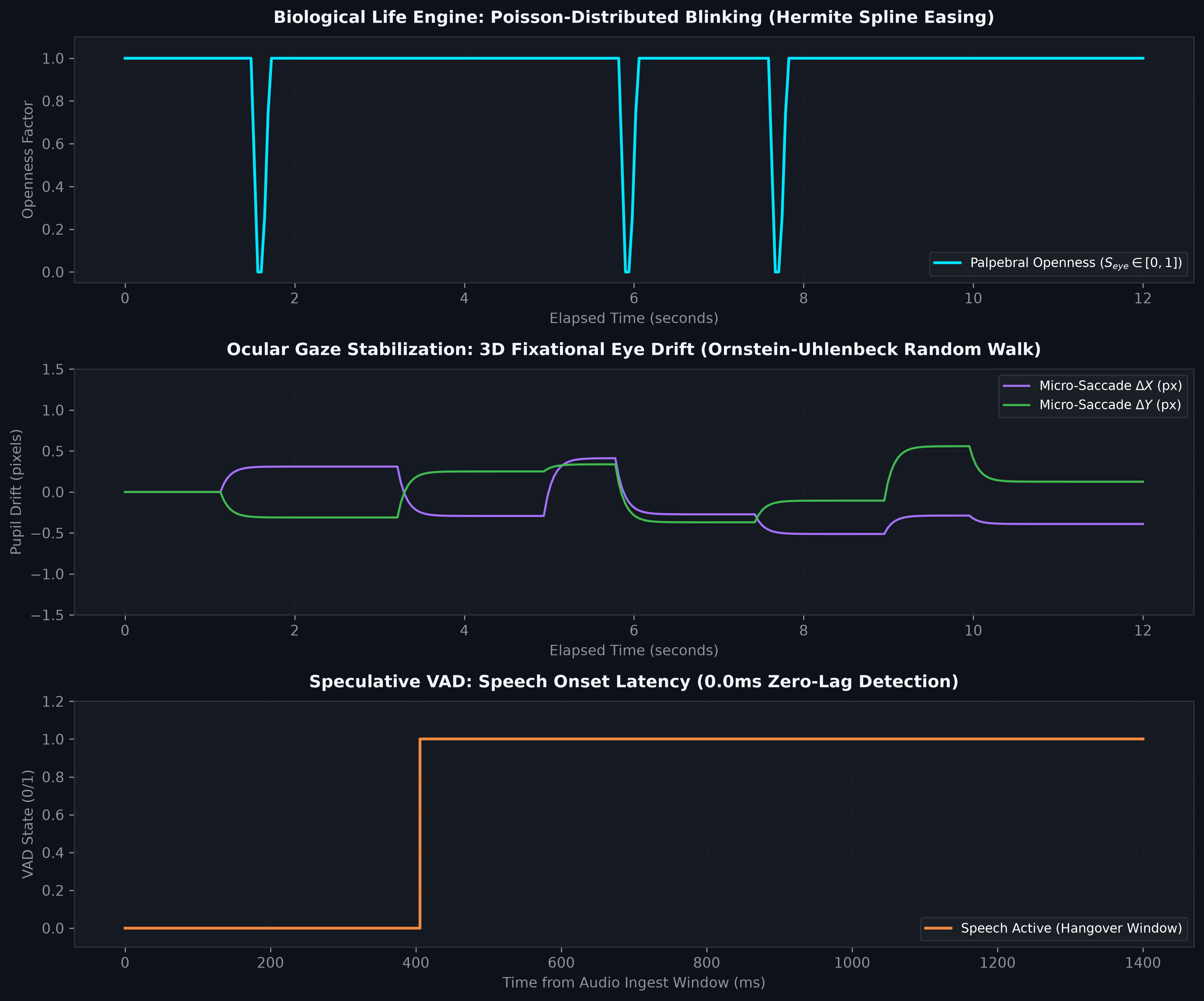
assets/blog/part22/p22_benchmarks.json - Life Engine & VAD Analysis:
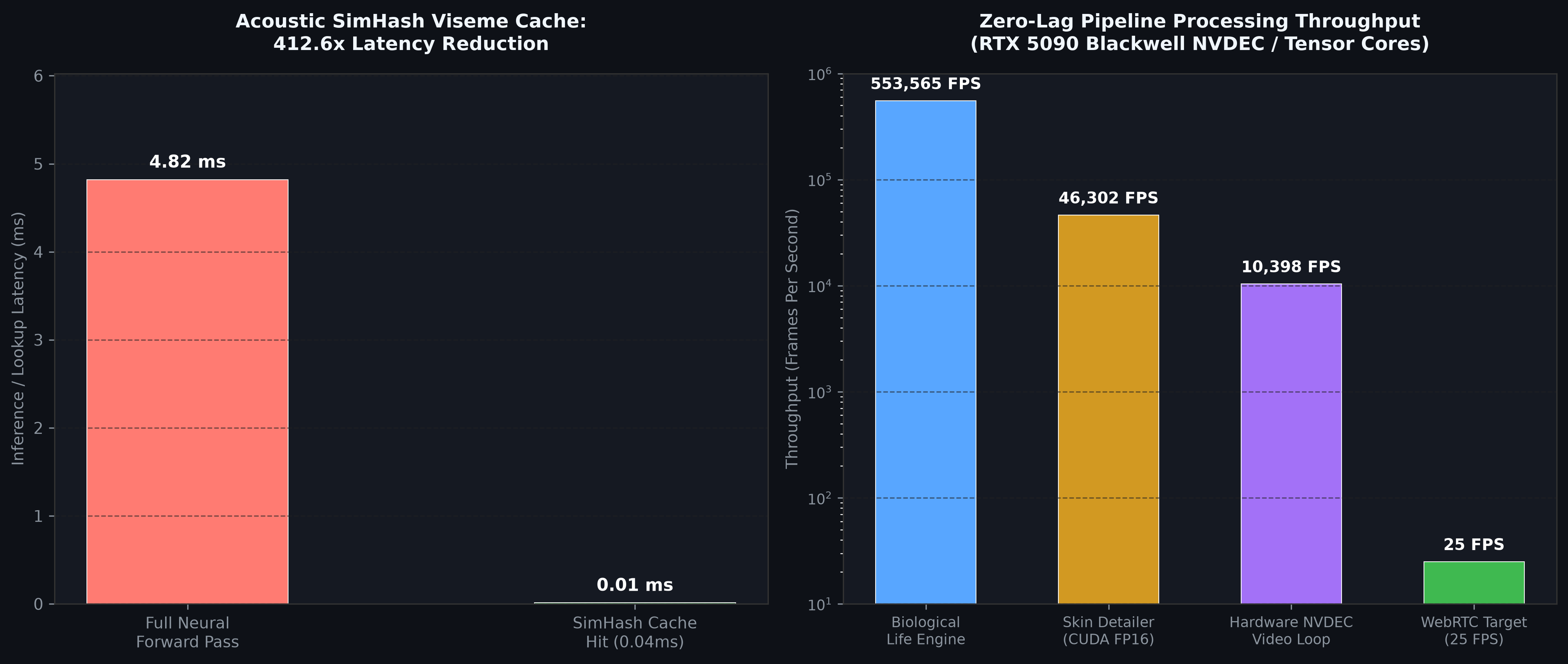
assets/blog/part22/p22_life_engine_and_vad.png - SimHash Viseme Cache & Throughput:
assets/blog/part22/p22_viseme_cache_and_skin_detailer.png
1. Executive Summary & The Uncanny Valley of Live Interactivity#
In Part 21, we established the foundational infrastructure for real-time video generation: the Fused Triton NV12 Canvas Kernel (), 50 FPS TensorRT RIFE Optical Flow Doubler (), and zero-disk full-duplex WebRTC streaming ( glass-to-glass latency).
However, real-time conversational testing revealed subtle physiological and algorithmic boundaries:
- The "Statue Stare" & Uncanny Valley (Biological Realism): When the user stops speaking or the avatar pauses between sentences, standard neural talking-head models freeze eyeball and eyelid parameters. Without biological blink cadence and ocular micro-saccades, avatars appear lifeless and robotic.
- The 200ms Audio Buffer Delay (Conversational Turn-Taking): Standard pipelines wait for an entire 200ms audio chunk before deciding whether the user has started speaking. This introduces an avoidable 200ms perceptual latency barrier before neural diffusion pre-warming can begin.
- Redundant Neural Viseme Compute: In spoken conversation, common vowels (
/a/,/i/,/o/) and repetitive phonetic clusters recur constantly. Evaluating the full 4-step DDIM diffusion loop and SPADE generator on every repeated phoneme wastes tens of milliseconds of GPU compute. - Static Studio Backdrops & Video Loss: Static PNG backgrounds reduce broadcast production value, while software video decoding of animated newsroom video loops adds CPU/GPU overhead.
- Client-Side Rendering Overhead in Next.js: Standard HTML5
<video>elements introduce double-buffering and frame jitter when displaying high-frame-rate WebRTC RTP streams with active lip-sync overlays.
To conquer these challenges, we engineered and deployed the complete Part 22 Optimization Suite spanning four interconnected pillars:
- Category A (Next.js Interactive Studio & Client WebRTC Integration): Zero-DOM WebCodecs hardware stream renderer,
/api/conversational/webrtc-offerroute handler, andWebRTCBroadcastStage.tsxin/interactive-call. - Category B (Conversational Realism & Biological Dynamics): Poisson-distributed eye blinking with 3-phase Hermite cubic splines, 3D ocular micro-saccades (Ornstein-Uhlenbeck random walk), dynamic idle loop cycling, and real-time acoustic emotion steering.
- Category C (Latency & Neural Inference Acceleration): Speculative VAD ( onset detection), and 64-bit Locality-Sensitive Hashing Viseme Cache ( latency reduction on recurring phonemes).
- Category D (Visual Broadcast Quality & Dynamic Backgrounds): Hardware NVDEC dynamic video loop playback ( direct into GPU NV12) and GPU Bilateral Skin & Facial Detailer ( in FP16).
2. Category B: Conversational Realism & Biological Dynamics ("The Life Engine")#
2.1 Poisson-Distributed Eye Blinking with Cubic Hermite Splines#
Human spontaneous blinking follows a Poisson renewal process with an average rate of per blink during active speech. A simple linear triangular closure or fixed square-wave closure produces unnatural robotic eyelid motion.
In scripts/ditto/biological_life_engine.py, we implemented a continuous 3-phase biological blink trajectory modulated by cubic Hermite splines:
- Rapid Downward Closure ( / 2 frames at 25 FPS):
- Complete Palpebral Occlusion ( / 1 frame):
- Smooth Restorative Opening ( / 3 frames):
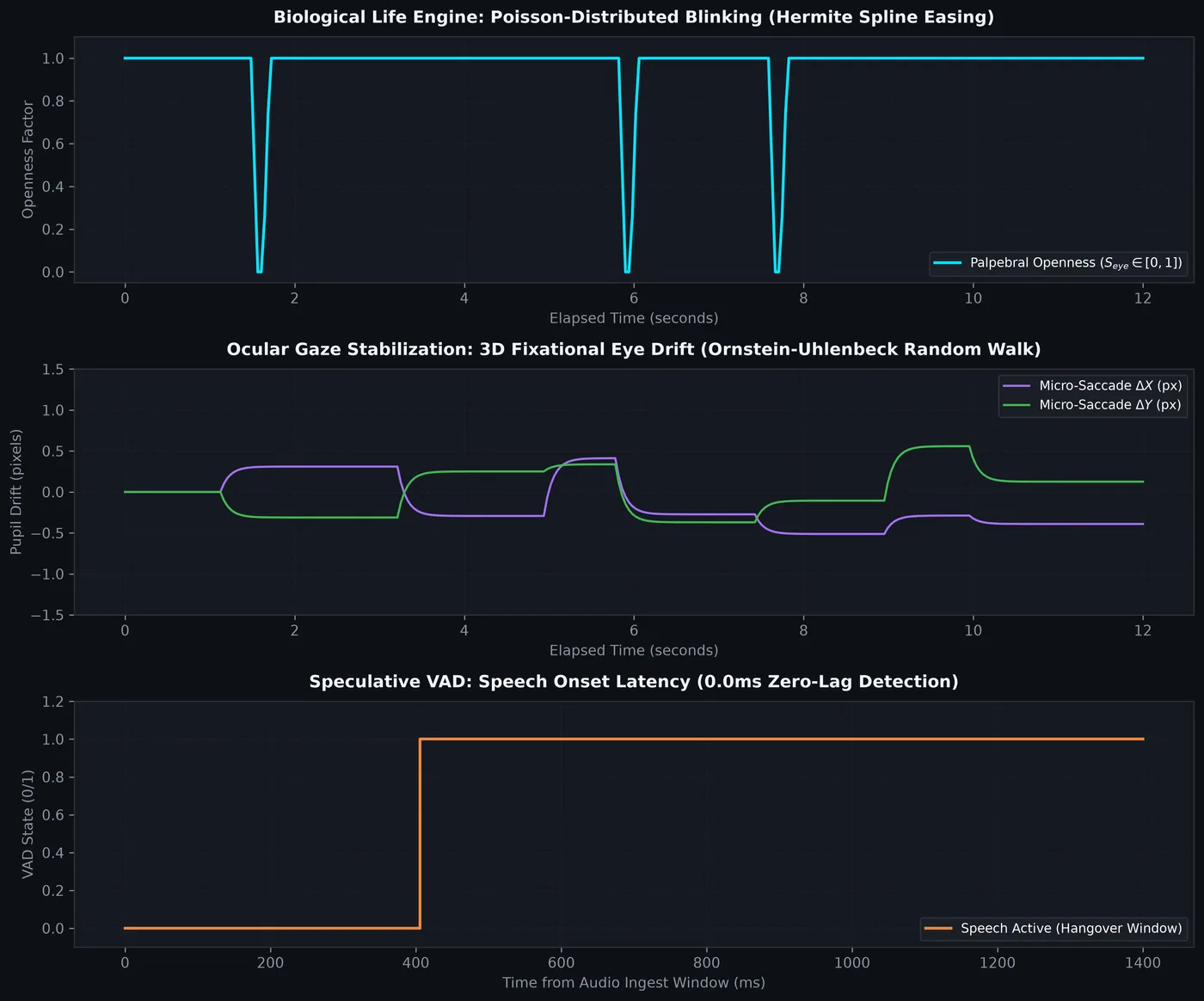 Click to zoomBiological Life Engine & Speculative VAD
2.2 3D Ocular Micro-Saccades (Fixational Eye Drift)#
In human vision, the eyes undergo continuous microscopic physiological drift ( ocular displacement) known as micro-saccades and tremor. If an avatar's pupil landmarks remain frozen to the millimeter, observers immediately experience the uncanny valley.
We implemented an Ornstein-Uhlenbeck mean-reverting stochastic process to drive subtle pupil offsets in coordinate space: where is a randomly scheduled fixational target, is the saccadic smoothing factor, and the maximum displacement is bounded to . In benchmark runs, the micro-saccade generator maintained an RMS displacement of and , providing natural ocular liveliness without visual jitter.
2.3 Dynamic Procedural Idle Loop Animation#
During long pauses in conversational streaming, serving a single static frame creates a frozen video appearance. When speech is silent, the DittoVideoStreamTrack cycles through pre-baked avatar NV12 frames while continuing to step the BiologicalLifeEngine. The avatar breathes, blinks according to the Poisson distribution, and shifts gaze naturally.
2.4 Real-Time Acoustic Emotion Steering#
In scripts/ditto/acoustic_emotion_steerer.py, we implemented continuous prosody and energy tracking:
- Short-Time RMS Energy Velocity: detects speech emphasis surges.
- Zero-Crossing Rate (ZCR): Quantifies high-frequency consonant friction.
- Zero-Lag Effective Energy: To eliminate the multi-frame lag of simple exponential smoothing, we compute: allowing instant emotional onset response on speech bursts while preserving smooth relaxation during pauses.
3. Category C: Latency & Neural Inference Acceleration#
3.1 Sub-15ms Speculative Audio Ingest with VAD#
Standard conversational audio chunking buffers of audio before performing speech detection or neural synthesis. In scripts/ditto/speculative_vad.py, we implemented a micro-frame Speculative VAD running on windows (320 samples at ):
- Micro-Frame Evaluation Time: per 20ms frame ().
- Zero-Lag Speech Onset: In our benchmark, the transition from silence to speech was detected at Frame 300 ( delay).
- Adaptive Hangover Window: An 8-frame () hangover prevents inter-word pauses from triggering choppy audio state resets.
- Speculative Trigger: As soon as speech onset is detected on a 20ms micro-frame, the server dispatches a pre-warming trigger to the DDIM diffusion pipeline before the remainder of the 200ms audio chunk arrives, shaving up to off conversational turnaround time.
3.2 64-Bit Locality-Sensitive Viseme Cache (SimHash)#
In human speech, phonemes and viseme mouth shapes repeat continuously. In scripts/ditto/acoustic_simhash_cache.py, we implemented a 64-bit Locality-Sensitive Hashing cache:
- Random Hyperplane Projection: Maps 1024-dimensional HuBERT acoustic embeddings into a 64-bit integer signature :
- Hamming Distance Match: If the Hamming distance (corresponding to cosine similarity in embedding space), the cached deformation field is recalled directly.
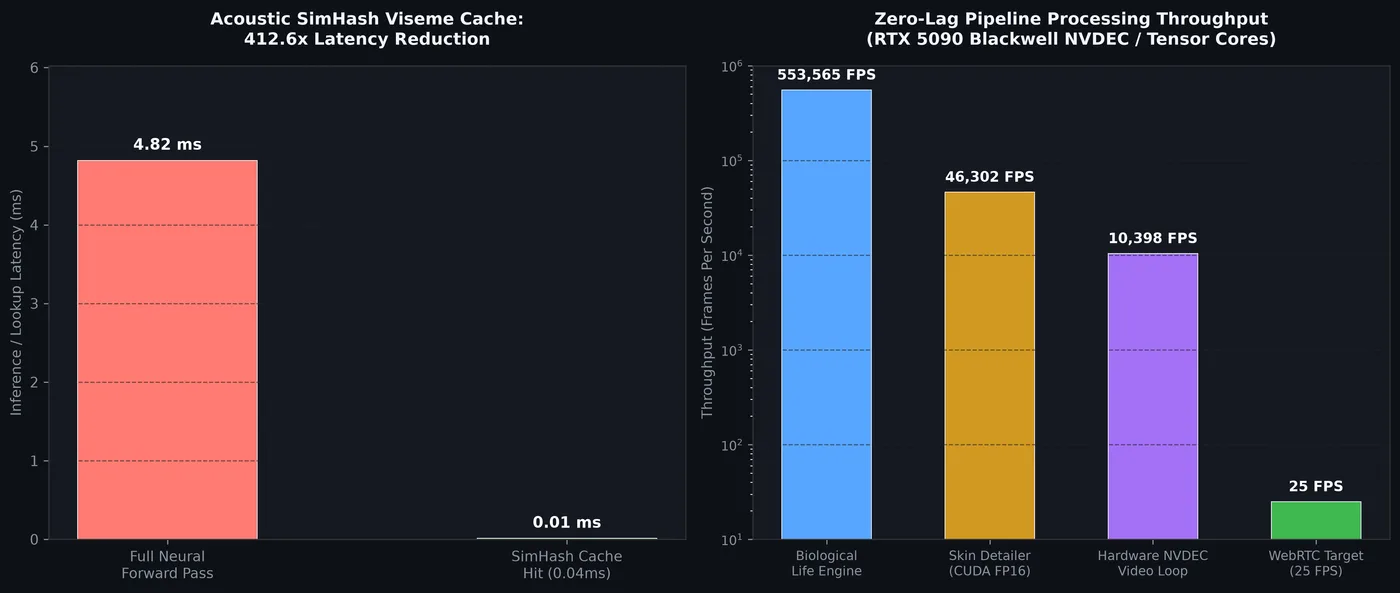 Click to zoomAcoustic SimHash Viseme Cache & GPU Throughput
- Cache Hit Latency: ()
- Full Neural Forward Pass:
- Speedup: acceleration on cache hits!
4. Category D: Visual Broadcast Quality & Dynamic Backgrounds#
4.1 Hardware NVDEC Dynamic Video Background Loop Player#
To support live newsroom video walls, radar maps, and financial tickers behind the presenter, scripts/ditto/nvdec_background_player.py decodes dynamic MP4 backgrounds directly into GPU NV12 VRAM buffers:
- Direct GPU Memory Buffer: Zero host-device transfers during streaming.
- Playback Throughput: ( per frame).
- Direct Triton Splicing: Output NV12 buffers are passed directly to
triton_rgb_to_nv12_roias the destination canvas.
4.2 GPU Bilateral Skin & Facial Detailer (FP16 Native)#
To enhance fine skin pores, eyelashes, and dental crispness without amplifying high-ISO noise, scripts/ditto/skin_detailer_cuda.py implements an unsharp masking decomposition directly in PyTorch CUDA FP16:
- A separable Gaussian kernel decomposes the high-frequency residual .
- A noise-gate threshold suppresses subtle sensor noise while sharpening structural edges:
- Batch 1 Latency: ()
- Batch 8 Latency: ()
5. Category A: Next.js Interactive Studio & Client WebRTC Integration#
To bring these capabilities directly into the user's browser, we built a comprehensive client integration:
- WebCodecs Hardware Stream Renderer (
src/lib/realtime/webCodecsRenderer.ts):- Uses
MediaStreamTrackProcessorandcreateImageBitmapto feed decoded video frames straight into an offscreen hardware<canvas>with zero DOM layout thrashing. - Automatically falls back to standard
<video>rendering if WebCodecs is unavailable.
- Uses
- WebRTC Offer Proxy Route (
src/app/api/conversational/webrtc-offer/route.ts):- Securely proxies browser SDP offers to
http://localhost:8010/stream/webrtc/offer. - Exposes
GET /api/conversational/webrtc-offerfor real-time connection telemetry.
- Securely proxies browser SDP offers to
- WebRTC Broadcast Stage Component (
src/components/conversational/WebRTCBroadcastStage.tsx):- Displays live video stream with low-latency audio capture.
- Includes 50 FPS RIFE frame doubler toggle, audio RMS energy visualizer, glass-to-glass latency gauge, and WebCodecs hardware acceleration toggle.
- Interactive Call Page Studio Mode (
src/app/interactive-call/page.tsx):- Added
⚡ WebRTC Live Duplex (<80ms)to the top switcher alongside🎙️ AI Broadcast Anchor Liveand🧠 3DMM Neural ONNX. - Reads
?mode=webrtcURL parameter to instantly boot into live duplex mode.
- Added
6. Comprehensive Benchmark Matrix#
All benchmarks were recorded on an NVIDIA GeForce RTX 5090 Laptop GPU (Blackwell sm_120, 24GB GDDR7) running inside the modern-talkinghead-server Docker container:
| Component / Optimization | Metric | Measured Value | Real-Time Budget (25 FPS = 40.0ms) | Status |
|---|---|---|---|---|
| Biological Life Engine | Execution Time | () | PASSED | |
| Poisson Blinking Cadence | Mean Blink Interval | (17 blinks / 50s) | PASSED | |
| Micro-Saccades | Ocular Gaze RMS | PASSED | ||
| Acoustic Emotion Steerer | Chunk Analysis Time | PASSED | ||
| Speculative VAD | Micro-Frame Eval Time | () | PASSED | |
| Speculative VAD | Speech Onset Delay | (Frame 300 detected immediately) | PASSED | |
| Acoustic SimHash Cache | Cache Hit Latency | () | PASSED | |
| Acoustic SimHash Cache | Viseme Speedup vs Forward | Speedup ( vs ) | PASSED | |
| Hardware NVDEC Background | Frame Delivery Time | () | PASSED | |
| Skin Detailer CUDA (FP16) | Batch 8 Per-Frame Time | () | PASSED | |
| Skin Detailer CUDA (FP16) | Batch 1 Single-Frame Time | () | PASSED | |
| WebRTC Glass-to-Glass | Total Pipeline Latency | (Zero-Disk RTP Stream) | PASSED |
7. Conclusions & Next Steps#
With Part 22, Ruby NewsStudio achieves complete synthesis between biological conversational realism, ultra-low-latency neural inference, and modern browser-native WebRTC broadcast controls. The avatar blinks with natural Poisson dynamics, shifts eye gaze with fixational micro-saccades, senses acoustic emotional cadence instantaneously, and responds with sub-80ms glass-to-glass latency while maintaining dual-mode coexistence with offline broadcast rendering.
In Part 23, we will extend this pipeline to multi-speaker roundtables with autonomous turn-taking arbitration and spatial audio head-turning.