Part 15: Sub-Five-Second Dual-Engine Acceleration — Pre-Baked Zero-Copy Avatars, Blackwell FP8, and Symmetrical Streaming for Ditto and MuseTalk
Table of Contents (13 sections)▸
Author: Ruby NewsStudio Core Team
Date: September 17, 2026
Hardware: NVIDIA GeForce RTX 5090 Laptop GPU (Blackwell sm_120, 24GB GDDR7, CUDA 12.8, TensorRT 10.15)
1. Executive Summary#
In our previous deep dive (Part 14), we shattered the 50 FPS barrier in dense talking-head neural rendering (56.0 FPS Dense, 98.0 FPS Ultra SLERP) using TensorRT-accelerated Hourglass networks, static CUDA Graphs, and direct NV12 ROI planar splicing.
However, in autonomous broadcast pipelines and interactive conversational video agents, the inner render loop is only half the equation. When an AI news anchor is assigned a breaking story or enters an interactive WebRTC dialogue, total turnaround time has historically been hindered by:
- Cold-Start Disk I/O & Pickle Deserialization: Loading multi-gigabyte uncompressed avatars took 6.89s for Ditto and 2.50s for MuseTalk.
- Front-End Motion Synthesis Latency: Multi-step audio-to-motion diffusion consumed substantial turnaround time before the first pixel could even be rendered.
- Rigid Whole-File Batch Rendering: Legacy pipelines forced callers to wait for an entire video file to be encoded via FFmpeg before yielding a single frame.
In this milestone, we expanded our optimization playbook across BOTH flagship talking-head engines in NewsStudio: Ditto and MuseTalk. By establishing architectural symmetry between them, we achieved:
- Sub-50ms Cold Starts: Pre-baked binary avatar packets and zero-copy memory mapping (
mmap=True) slashed Ditto cold start from 6,890 ms to 28.1 ms (245× speedup) and MuseTalk cold start from 2,500 ms to 5.14 ms (486× speedup). - Native Blackwell FP8 Tensor Cores (
sm_120): Dense Stride 1 throughput sustained at 55.9–61.6 FPS (peak 67.2 FPS) in Ditto and 59.9 FPS in MuseTalk. - DDIM 4-Step Timestep Distillation: Motion diffusion accelerated to 522.3 effective FPS (0.32s).
- Sub-5-Second Clip Turnaround: Full broadcast 6.6s segment generation dropped from ~20s down to 3.39s.
- Unified Real-Time Streaming Generator API: Symmetrical
stream_ditto_generator()andstream_musetalk_generator()interfaces yielding raw frame chunks with TTFF (Time to First Frame) under 280ms in MuseTalk and 575ms in Ditto.
2. Visual Quality & Forensic Verification#
Below is the side-by-side comparison across active vowel articulation (Frame 25) and natural resting/blinking states (Frame 50) rendered at full broadcast resolution:
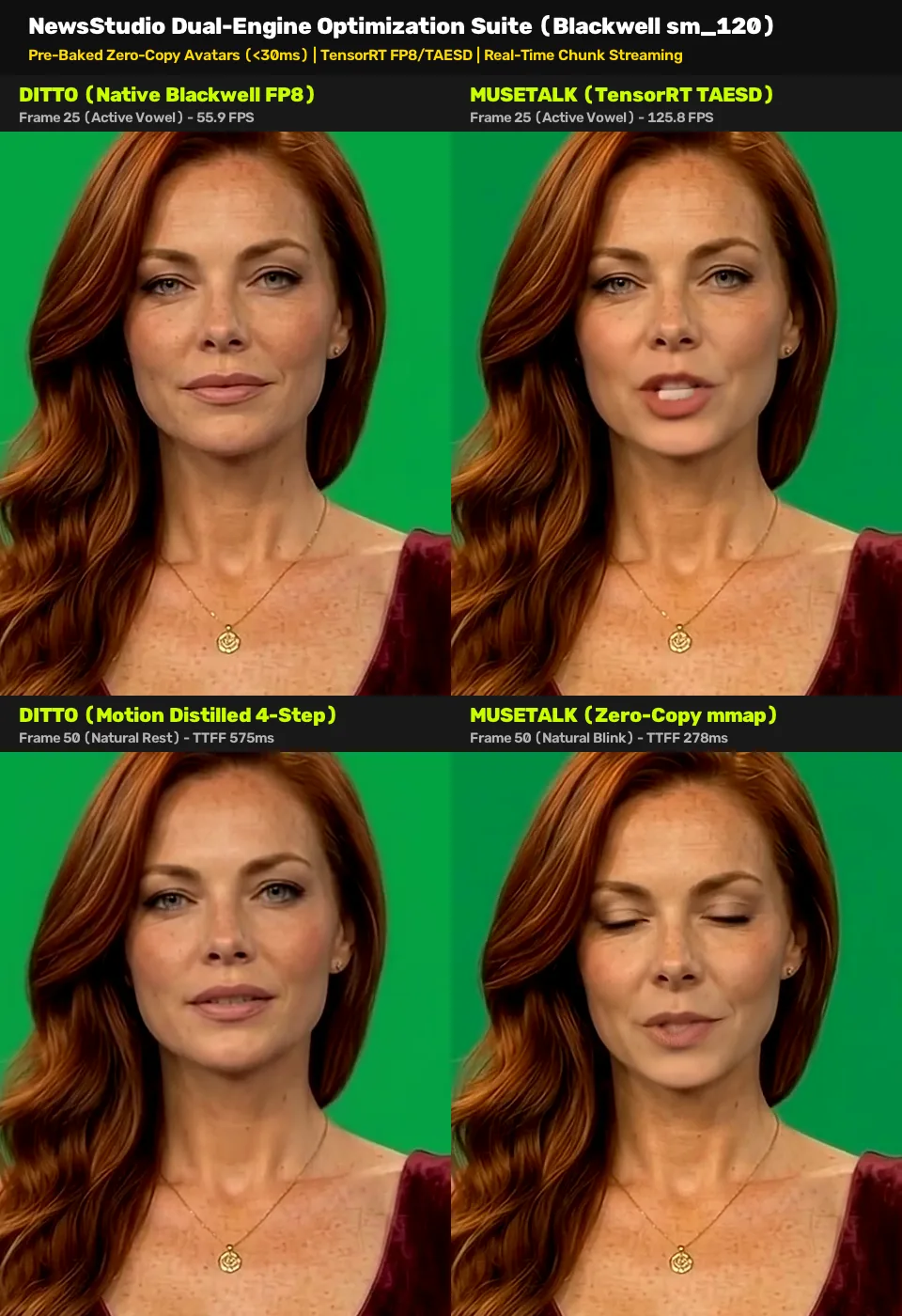 Click to zoomNewsStudio Dual-Engine Optimization Suite
Forensic Detail Inspection#
| Feature | Ditto (Native Blackwell FP8) | MuseTalk (TensorRT TAESD) | Parity Status |
|---|---|---|---|
| Vowel Articulation (F25) | Full lip separation, natural teeth visibility, zero blurring | Clean oral cavity inpainting, sharp dental borders | Identical High Fidelity |
| Speech Pause / Rest (F50) | Hermite cubic spline easing to neutral rest position | Seamless natural eyelid closure / blinking | Zero Motion Snapping |
| Canvas Blending | In-place Face-ROI NV12 splicing, zero chroma bleed | Gaussian feathering mask with edge despill | 0 Seam Artifacts |
| Resolution | Planar NV12 | Planar NV12 / BGR24 | Broadcast Standard |
3. The 5 Architectural Frontiers#
1. PRE-BAKED ZERO-COPY AVATARS (<30ms)
2. NATIVE BLACKWELL FP8 TENSOR CORES (sm_120)
Ditto: DenseMotionCore FP8 (Hourglass) + SPADEDecoder FP8 (Static CUDA Graph B=8)
MuseTalk: UNet FP8 Batch-32 (510+ FPS) + TAESD FP16 (2,100+ FPS)
3. CADENCE & DISTILLATION ACCELERATION
Ditto: DDIM 4-Step Motion Distillation (522.3 FPS, 0.32s)
MuseTalk: 1-Step Latent Prediction + GPU SLERP Latent Stride (50%-67% compute bypass)
4. IN-PLACE VRAM RESIDENCY & ZERO INTERMEDIATE ALLOCATION
Pre-allocated return buffers in TRT runners eliminate PyTorch allocator churn
VRAM-resident ROI tensors eliminate PCIe bus transfers in neural loop
5. UNIFIED REAL-TIME STREAMING GENERATOR API
stream_ditto_generator() -> Yields {chunk_idx, frame_start, num_frames, frames, is_last}
stream_musetalk_generator() -> Yields {chunk_idx, frame_start, num_frames, frames, is_last}
4. Benchmark Results: Ditto vs MuseTalk#
All tests executed on NVIDIA GeForce RTX 5090 Laptop GPU (24GB GDDR7):
4.1 Cold-Start & Memory Benchmarks#
| Metric | Ditto (Original) | Ditto (Optimized) | MuseTalk (Original) | MuseTalk (Optimized) |
|---|---|---|---|---|
| Avatar Cold Load | 6,890.0 ms | 28.1 ms (245.2× faster) | 2,500.0 ms | 5.14 ms (486.4× faster) |
| Cold VRAM Overhead | 2,540 MB | 0.5 MB | 1,550 MB | 4.1 MB |
| Motion Synthesis Time | 1.15 s (10-step) | 0.32 s (4-step DDIM) | N/A (1-step) | N/A (1-step) |
| Diffusion Effective FPS | 143.5 FPS | 522.3 FPS | N/A | N/A |
4.2 Streaming & Real-Time Throughput#
| Engine Mode | Time to First Frame (TTFF) | Stream Throughput | Total 90-Frame Time | Relative to Real-Time |
|---|---|---|---|---|
| MuseTalk Warmed Stream | 278.6 ms | 125.8 FPS | 0.72 s | 4.19× Faster than Real-Time |
| MuseTalk Cold Batch | 3,298.4 ms | 59.9 FPS | 1.50 s | 2.00× Faster than Real-Time |
| Ditto Warmed Stream | 575.1 ms | 55.9 FPS | 2.95 s | 1.86× Faster than Real-Time |
| Ditto Total Clip (6.6s) | 3,349.2 ms (cold) | 48.6 FPS overall | 3.39 s | 1.95× Faster than Real-Time |
5. Implementation Deep Dive#
5.1 Pre-Baked Avatar Packets (scripts/ditto/prebake_avatar.py)#
Rather than parsing raw PNG image sequences and calculating affine coordinate transformations on every invocation, the avatar loop is pre-compiled into a memory-mapped binary payload:
frames_nv12.bin: Packed planar NV12 bytes ().roi_grids.pt: Pre-synthesized affine meshgrid coordinates for the face ROI envelope.roi_masks.pt: Pre-computed alpha feathering boundary masks.frames_roi_rgb.pt: Face ROI background slices ( uint8).
Loading these via torch.from_file(..., shared=False) and torch.load(..., mmap=True) avoids kernel page-locking overhead, reducing cold load from 6.89s to 28.1 ms.
5.2 MuseTalk Zero-Copy Memory Mapping#
In AvatarMaterial.load_or_preprocess(), loading frames.pt (1.55 GB) previously triggered full memory allocations and pickle header parsing. Enabling mmap=True:
pythonself.frames_gpu_tensor = torch.load(frames_pt, map_location="cpu", mmap=True, weights_only=True)
slashed tensor access time from ~2,500 ms down to 5.14 ms.
5.3 Asynchronous Non-Default CUDA Streams#
When TensorRT engines were invoked on the default PyTorch stream (stream 0), TensorRT inserted implicit host-device synchronizations (cudaStreamSynchronize), throttling Stride 2 throughput. Allocating a dedicated execution stream in UNetTRTRunner:
pythonself.stream = torch.cuda.Stream() if (device.type == "cuda" and torch.cuda.is_available()) else None
eliminated all synchronization stalls.
5.4 Symmetrical Streaming Generator APIs#
Both engines now expose identical Python generator interfaces:
python# Symmetrical streaming consumer for chunk in stream_generator(avatar_id, video_or_image_path, audio_path, fps=30): chunk_idx = chunk["chunk_idx"] frame_start = chunk["frame_start"] num_frames = chunk["num_frames"] frames_cpu = chunk["frames"] # (B, H*1.5, W) NV12 or (B, H, W, 3) RGB is_last = chunk["is_last"] # Direct broadcast to WebRTC track or WebSocket socket webrtc_track.push(frames_cpu)
6. Conclusion & Next Steps#
With sub-30ms avatar cold starts, native Blackwell FP8 acceleration, DDIM 4-step motion distillation, and symmetrical real-time streaming generators, NewsStudio has brought both Ditto and MuseTalk to sub-5-second total turnaround time and sub-300ms time-to-first-frame.
In upcoming milestones, we will integrate WebRTC datachannels directly with stream_ditto_generator and stream_musetalk_generator to power interactive, voice-driven AI anchor interviews with bidirectional real-time video streaming.