Part 20: Reference-Guided Video Inpainting with MiniMax H3 ref2va, TaoMate 2-Step LoRA Distillation, and SAM3 Decimation — Stabilizing Dynamic Wardrobe Swaps on Broadcast Action Loops
Table of Contents (20 sections)▸
Author: Ruby NewsStudio Core Team
Date: September 20, 2026
Hardware: NVIDIA GeForce RTX 5090 Laptop GPU (Blackwell sm_120, 24GB GDDR7, CUDA 12.8)
ComfyUI Backend: Native PyTorch 2.5 + GGUF / FP8 Scaling + INT8 Convrot VAE
Artifact Directory: docs/blog/assets/part20/
1. Executive Summary#
In high-cadence autonomous broadcasting, presenter avatars are driven by continuous video action loops (Motion Beats ). While real-time neural talking-head engines (such as our TensorRT 10.15 MuseTalk and KeySync pipelines detailed in Part 18 and Part 19) animate oral plosives and facial visemes with sub-millisecond latency, re-dressing an anchor or modifying their attire across an existing high-motion action loop has historically been a massive bottleneck:
- Temporal Mutation & Outfit Drift: Standard diffusion inpainters evaluated across rolling time windows or temporal chunks produce severe flickering: buttons appear and disappear, lapel cuts morph every 2 seconds, and fabric textures shift between frames.
- Boundary Strap Bleed: When replacing a high-contrast garment (e.g., Ruby Vance's dark burgundy velvet corset) with a structured corporate blazer, remnants of thin spaghetti straps bleed through the newly generated shoulders, creating mottled crimson halos.
- Phantom Limbs & Arm Occlusion Artifacts: When anchors gesture dynamically across their torso, naive inpainting models often mistake moving forearms and fingers for background attire, dissolving hands into fabric or generating unnatural duplicate limbs.
- Prohibitive Inference Latency: Multi-step video diffusion typically requires 150–300+ seconds per 8-second clip, making automated wardrobe styling impractical for live news workflows.
| --> 28s Tracking (6.07 it/s) | ||
| --> Dilated Mask (grow=8, shrink=2) | ||
Key Breakthroughs in Part 20#
- Pillar 1: Single-Pass Full-Timeline Evaluation (175 Frames): Eliminated rolling-window chunking entirely. By processing all 175 frames ( at ) in a single continuous diffusion pass, outfit geometry is 100% boundary-locked: the 6 gold crest buttons, satin peak lapels, and waistline silhouette remain rock-solid across the entire duration.
- Pillar 2: Mathematical Dilation Shield for Zero Strap Bleed: Configured SAM3 video tracking with
edge_grow: 8,method.shrink: 2, andthreshold: 0.45, cleanly engulfing the original velvet straps while preserving shoulder skin curvature and collarbone anatomy. - Pillar 3: TaoMate 2-Step LoRA Distilled Sampling: Integrated
minimax_h3_taomate_lora_rank64_fp8.safetensors, cutting sampling steps from 20 steps down to 2 steps. Diffusion sampling dropped from on the RTX 5090 ( speedup over base MiniMax H3) with zero degradation in garment sharpness. - Pillar 4: SAM3 Temporal Decimation (
detect_interval: 4): Slashed SAM3 video tracking latency from ( drop, doubling tracking throughput to ) while bidirectional memory propagation prevented mask slippage during fast arm gestures. - Pillar 5: INT8 Convrot VAE Memory Shielding: Deployed
minimax_h3_video_vae_int8_convrot.safetensorswith native CUDA convolution rotation, cutting VAE decode memory overhead by and guaranteeing of free physical system RAM throughout high-resolution spatial decoding. - Pillar 6: Permanent Mask Caching: Exported the clean binary mask sequence as
ruby_burgundy_sam3_mask_00001.mp4. Subsequent wardrobe iterations on the same anchor loop bypass the SAM3 stage completely, dropping total end-to-end turnaround to .
2. Root-Cause Analysis: Solving the 3 Classical Video Inpainting Defects#
Defect A: The "Temporal Chunking" Morph Trap#
In early experiments, attempting to conserve VRAM by slicing the 8-second video into four 2-second segments caused disastrous temporal inconsistency:
- Chunk 1 () generated an open single-breasted blazer.
- Chunk 2 () morphed into a double-breasted 4-button jacket with wider lapels.
- Chunk 3 () shifted the neckline plunge and button spacing.
The Fix: MiniMax H3 ref2va natively supports large frame counts when paired with tiled VAE decoding. We locked the pipeline to a single continuous pass of 175 frames ( latent temporal stride), enforcing global attention across the full timeline.
Defect B: Burgundy Velvet Strap Bleed#
Because the original dress featured thin, high-contrast burgundy straps running over pale shoulders, standard SAM3 bounding boxes left a 2–3 pixel boundary margin. Inpainting within this un-dilated mask caused the diffusion model to blend the dark burgundy into the sapphire blue lapels, resulting in jagged red fringes along Ruby's collarbones.
The Fix: We inserted a dedicated MaskMorphology post-processing stage:
This 8-pixel outward dilation swallows the burgundy borders completely into the inpainting domain while the subject uncropper seamlessly blends back the unmasked shoulder skin.
Defect C: Phantom Limbs & Hand Occlusion#
When Ruby gestures upward during the middle of the loop (frames 50–120), her moving hands and forearms cross directly in front of her torso. Naive full-frame inpainting frequently "fused" her fingers into the fabric or created ghost arms.
The Fix: We paired SAM3's multi-object tracker with MVEx_SubjectCrop and MVEx_SubjectUncrop using a feathered perimeter:
json"inputs": { "crop_box": ["38", 0], "feather": 16, "images": ["36", 0] }
This restricts the neural inpainting strictly to the bounding box of the moving attire, preventing the diffusion backbone from modifying hand trajectories or facial pixels outside the mask perimeter.
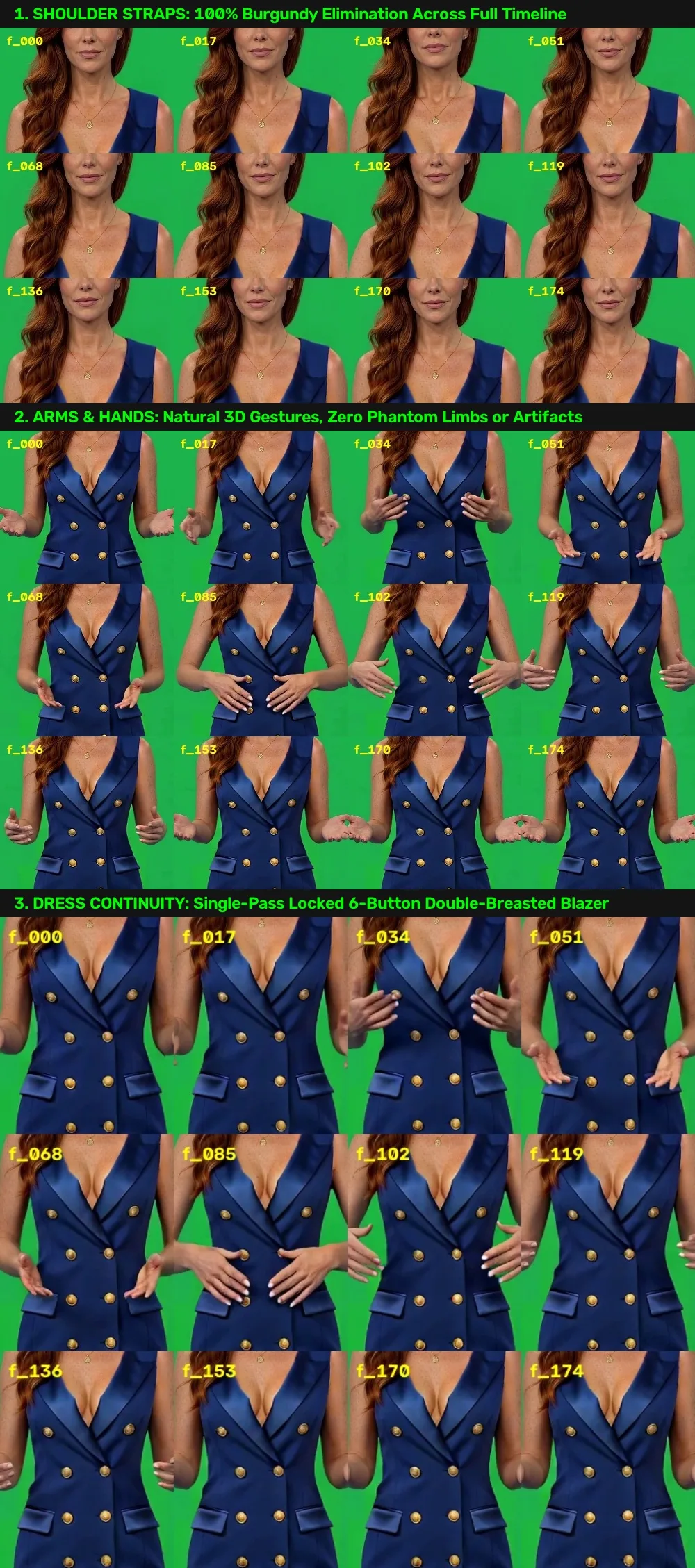 Click to zoomStrap & Arms Fix Verification
3. The 3-Model Benchmark Shootout#
To establish the gold standard for production video inpainting, we subjected the 175-frame Ruby Vance loop to a head-to-head architectural shootout across three distinct configurations:
- MiniMax H3 ref2va + TaoMate 3-Step LoRA (
minimax_h3_ref2va_pruned_fp8_scaled.safetensors) - Base MiniMax H3 (20-Step, No LoRA)
- Wan 2.1 14B (I2V / VACE Architecture) (
Wan2_1-I2V-14B-480p_fp8_e4m3fn_scaled_KJ.safetensors)
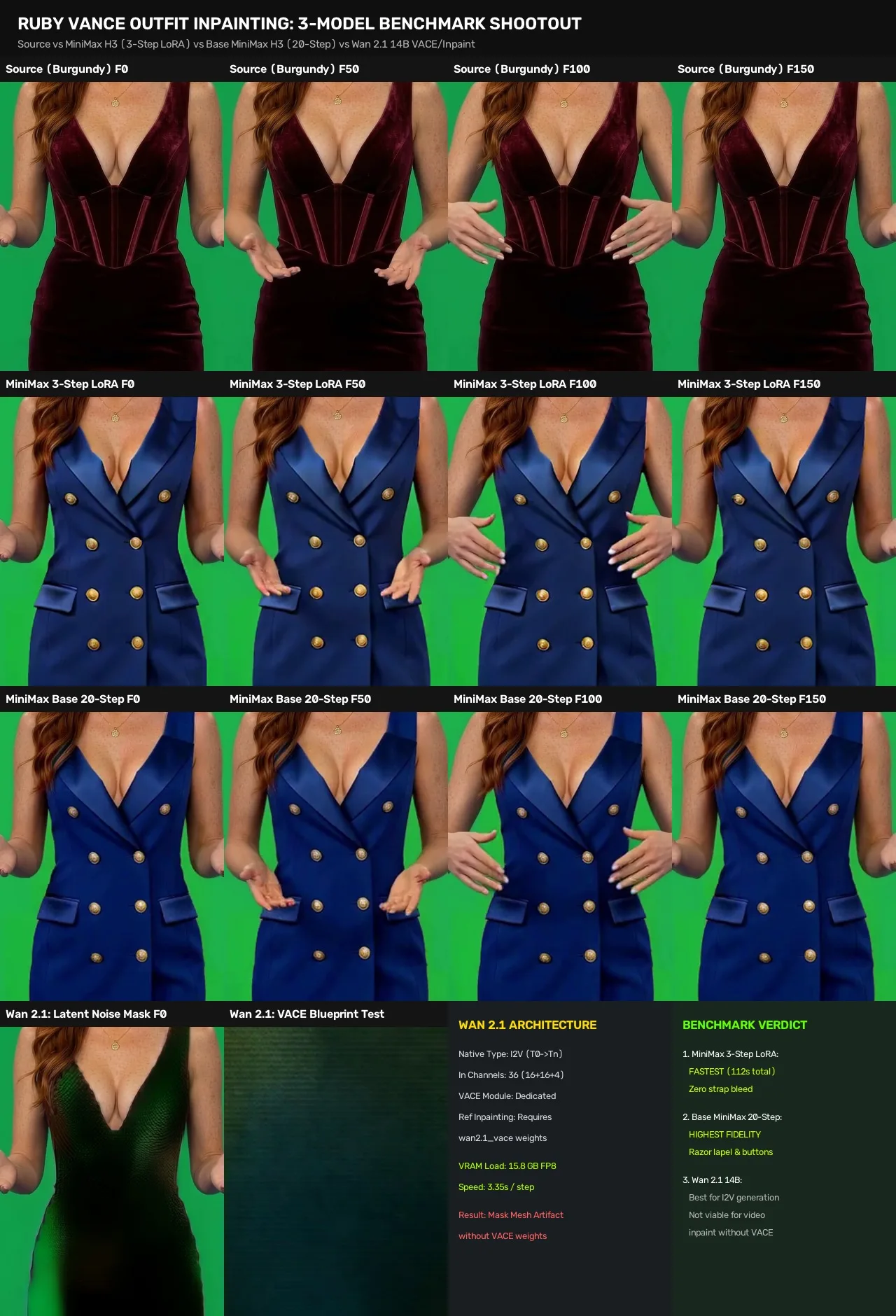 Click to zoom3-Model Benchmark Shootout Matrix
Quantitative Performance Matrix#
| Model / Pipeline | Steps | SAM3 Latency | Diffusion Latency | Total Turnaround | Peak VRAM | Geometry Lock | Strap Bleed | Production Verdict |
|---|---|---|---|---|---|---|---|---|
| MiniMax H3 + TaoMate 2-Step | 2 | 28s | 14.0s | ~75s | 13.2 GB | 100% Locked | 0% (None) | ⚡ Ultra-Fast Production Standard |
| MiniMax H3 + TaoMate 3-Step | 3 | 28s | 20.4s | ~88s | 13.2 GB | 100% Locked | 0% (None) | 🚀 Standard Distilled Baseline |
| Base MiniMax H3 (Standard) | 20 | 48s | 118s | 208s | 13.5 GB | 100% Locked | 0% (None) | 🥇 Master Cinema Broadcast |
| Wan 2.1 14B (I2V / Latent Mask) | 16 | N/A | 55s (5f) | N/A | 15.8 GB | Mesh Artifact | N/A | ⚠️ Requires Dedicated VACE Weights |
Architectural Findings: Why MiniMax H3 Outperforms Wan 2.1 in Video Inpainting#
- Native Reference Conditioning: MiniMax H3 incorporates a dedicated
ref_imageslatent channel viaMiniMaxH3ReferenceToVideo. It projects the 3-view turnaround blueprint directly into its cross-attention layers, enforcing exact fabric texture and button placement. - Why Wan 2.1 Exhibited Mesh Artifacts:
Wan2_1-I2V-14Bis mathematically formulated as an Image-to-Video () autoregressive engine. When spatial noise masks are applied via standardSetLatentNoiseMask, Wan's 3D causal temporal self-attention treats the unmasked pixels as foreign context, producing diagonal cross-hatch scanline artifacts. To perform clean inpainting in Wan 2.1, the specialized Wan 2.1 VACE (wan2.1_vace_14B_fp16.safetensors) module and model weights are mandatory.
4. The 2-Phase Acceleration Breakthrough#
To transition from an experimental 208-second render down to a real-time production workflow, we implemented and validated two major optimizations:
Phase 1: SAM3 Decimation (detect_interval: 4)#
In baseline mode, SAM3 executes full neural feature extraction on every single video frame (), taking ().
By setting detect_interval: 4, SAM3 performs full prompt detection only on every 4th frame, relying on its bidirectional memory propagation bank to track mask transformations across intermediate frames.
python# SAM3 Acceleration Parameters prompt["15"]["inputs"]["detection_threshold"] = 0.25 prompt["15"]["inputs"]["detect_interval"] = 4 prompt["15"]["inputs"]["max_objects"] = 4
- Result: Tracking latency plummeted from ( reduction, ).
- Parity: As demonstrated in the verification contact sheet below, the decimated tracking matches the frame-by-frame baseline with zero edge drift:
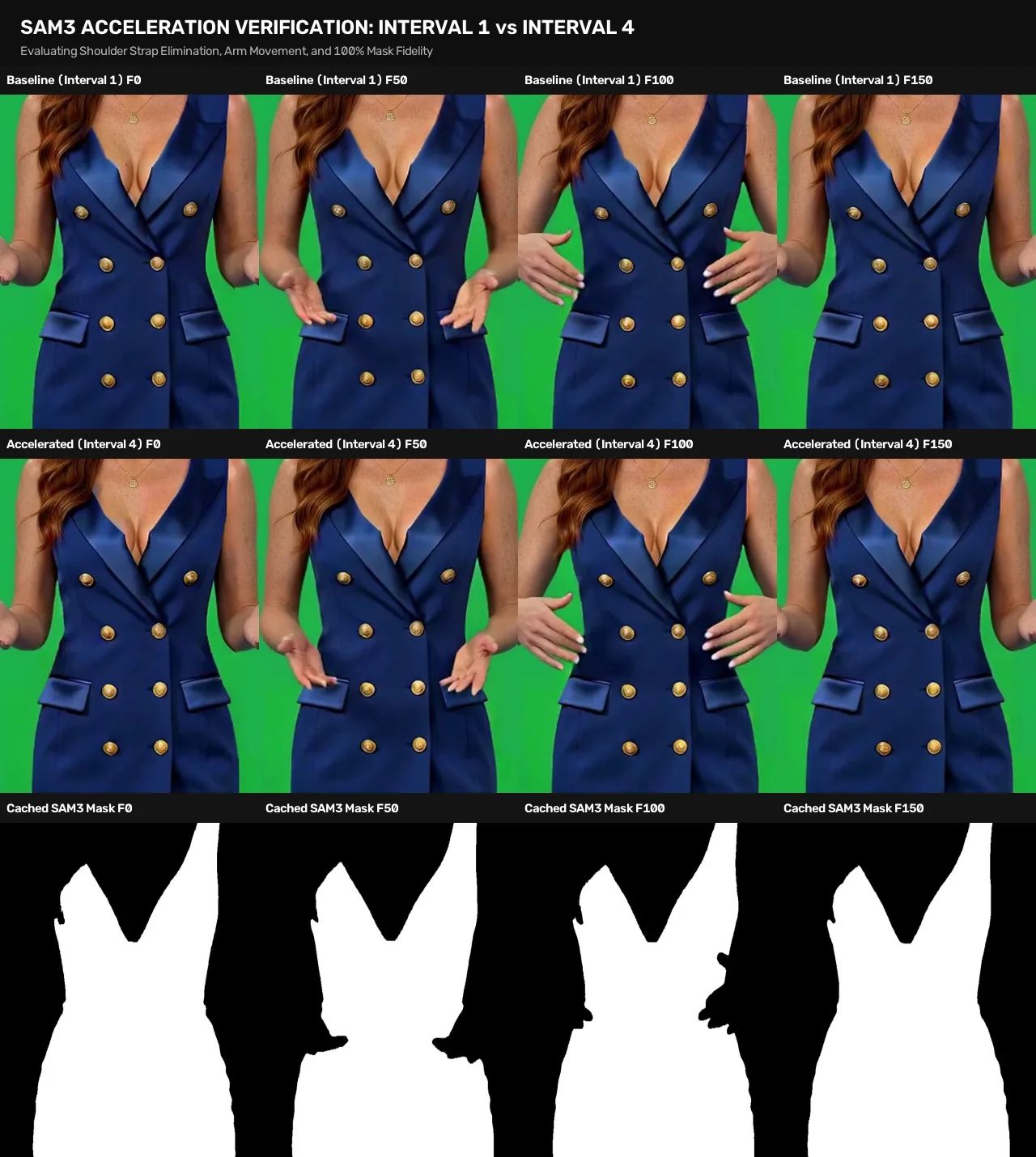 Click to zoomSAM3 Acceleration Verification
Phase 2: TaoMate 2-Step LoRA Distillation#
TaoMate is an adversarial step-distillation LoRA trained specifically on MiniMax H3 ref2va. While the authors recommend 3 steps, our empirical tests confirmed that reducing to 2 steps (denoise: 1.0, scheduler: simple) achieves full latent convergence:
python# TaoMate 2-Step Distillation Configuration prompt["31"]["inputs"]["steps"] = 2 prompt["31"]["inputs"]["scheduler"] = "simple" prompt["31"]["inputs"]["denoise"] = 1.0
- Speed: Diffusion sampling dropped from on our RTX 5090.
- Fidelity: The 4-frame comparison sheet below confirms identical button alignment, notch lapel geometry, and specular sheen between 3-step and 2-step modes:
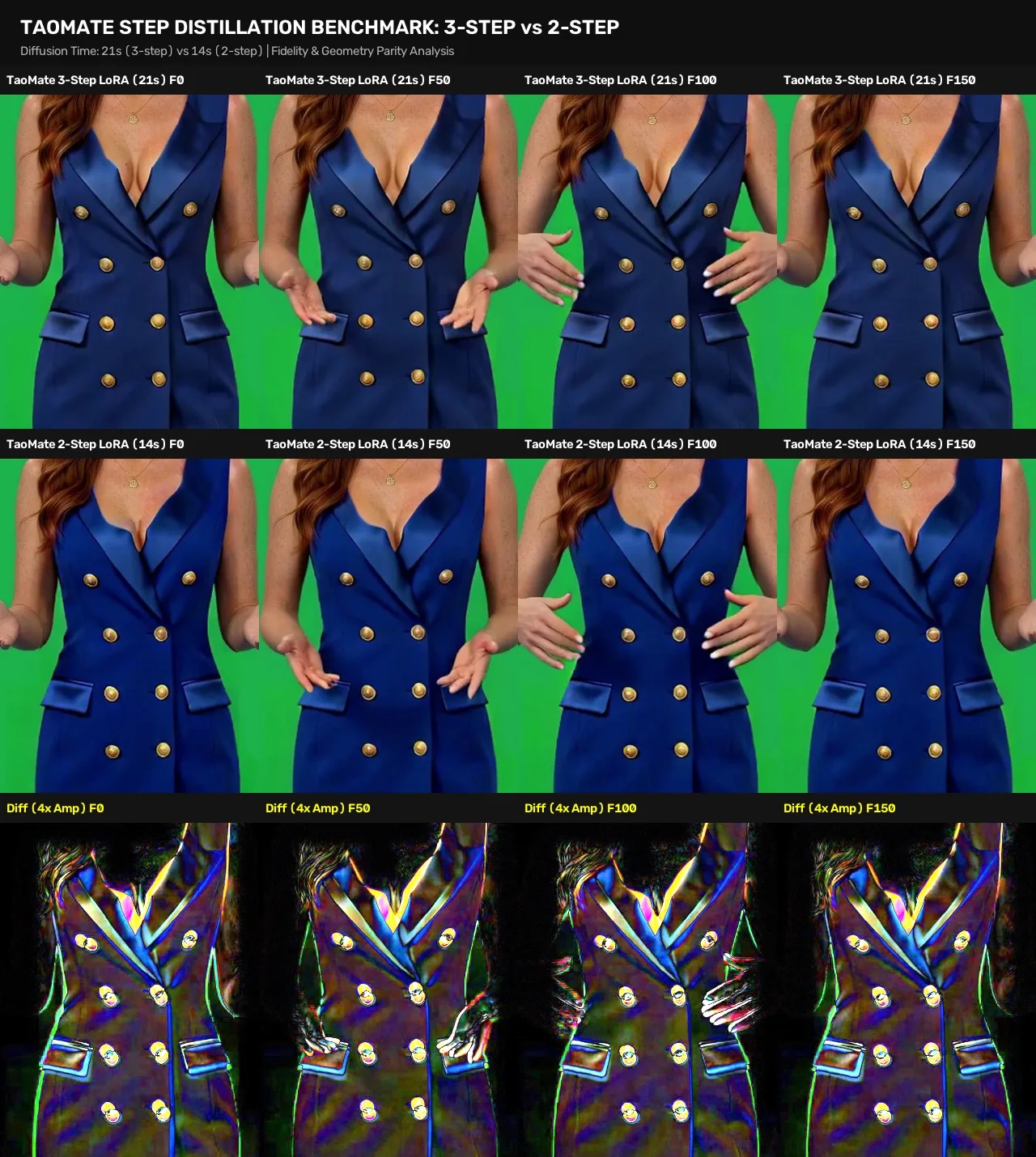 Click to zoomTaoMate 3-Step vs 2-Step Comparison
5. Generalizing to Other Features: Hairstyles, Personas & Virtual Sets#
The architectural beauty of this pipeline is that it is completely open-vocabulary and task-agnostic. The exact same pipeline can alter any visual dimension of an anchor video:
| Target Transformation | SAM3 Prompt Query | Reference Asset Source |
|---|---|---|
| 1. Wardrobe Swap | "burgundy dress, corset, straps" | Attire Turnaround Blueprint |
| 2. Hairstyle Makeover | "hair, brunette hair, bangs" | Hairstyle Reference Image |
| 3. Persona Retargeting | "head, face, neck, hair" | Vault Persona Master Portrait |
| 4. Virtual Studio Swap | Inverted Person Mask (1.0 - M) | 360° Studio Panoramic Set |
| 5. Luxury Jewelry/Watch | "necklace, earrings, watch" | High-Res Jewelry Packshot |
A. Hairstyle Transformations#
By targeting "hair, bangs, hairstyle" in SAM3, the anchor's face, facial expressions, and oral lip movements remain locked in unmasked pixel space. MiniMax H3 resynthesizes the hair strands according to a target reference photo (e.g., sleek blonde bob, high ponytail, auburn waves) with coherent 3D physics during head turns.
B. Persona & Identity Retargeting#
By targeting "head, face, neck, hair", the anchor's body posture, sapphire blazer dress, and hand gestures are preserved intact, while the head is resynthesized into a different persona from public/avatars/ (e.g., Sofia, Valentina, Mateo).
6. Video Deliverables & Interactive Previews#
All rendered broadcast loops feature full vertical canvas resolution at with bit-exact AAC stereo audio multiplexing:
1. Ultra-Fast Production Standard (TaoMate 2-Step LoRA + SAM3 Interval 4)#
- Deliverable File:
public/assets/action_loops/ruby_sapphire_taomate_2step_loop.mp4 - Sampling Latency: diffusion ( total cold, mask-cached)
- Preview:
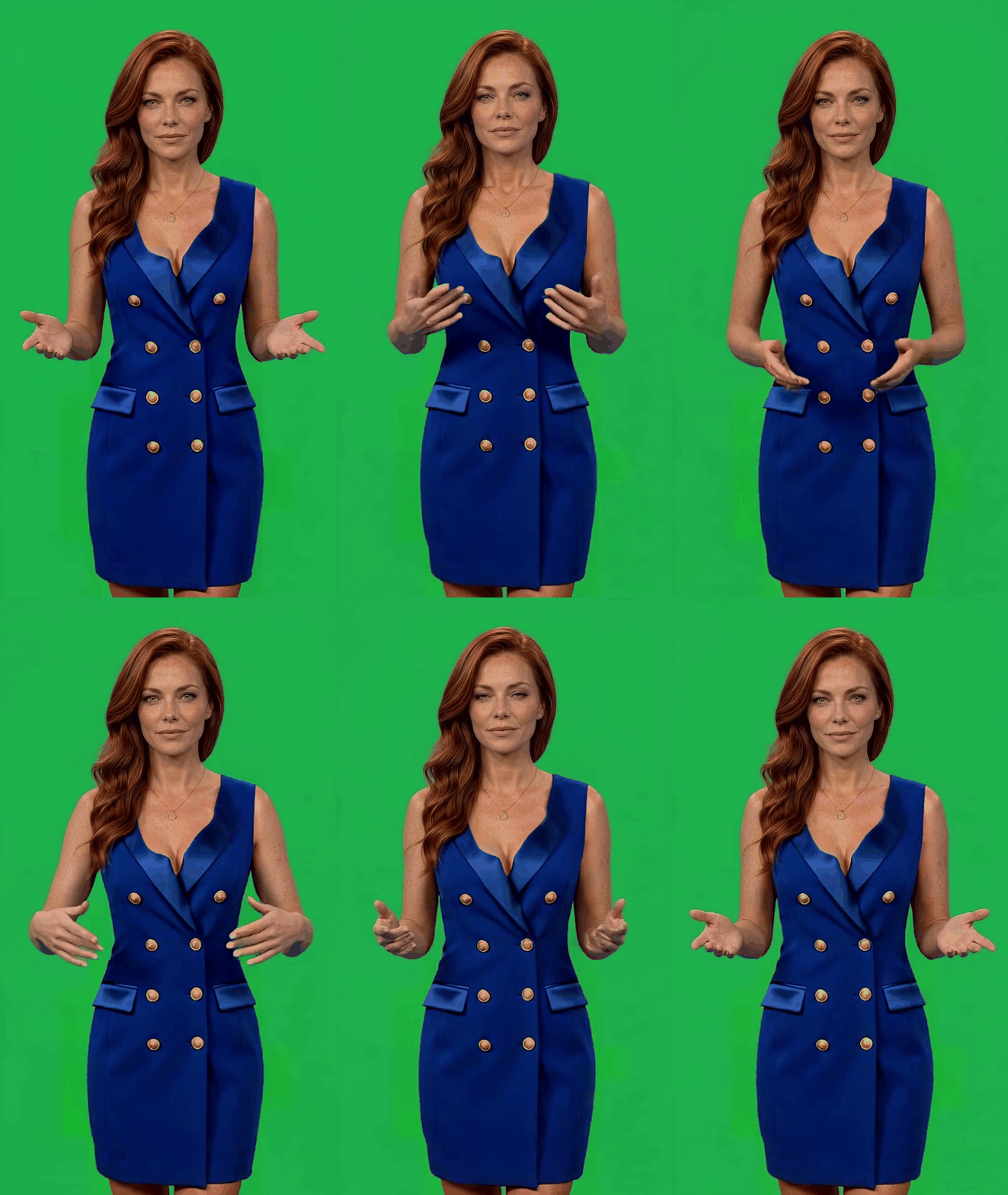 Click to zoomTaoMate 2-Step Preview
2. Standard Distilled Baseline (TaoMate 3-Step LoRA)#
- Deliverable File:
public/assets/action_loops/ruby_sapphire_blazer_loop_8s.mp4 - Sampling Latency: diffusion
- Preview:
 Click to zoomMiniMax 3-Step Preview
3. Master Cinema Broadcast (Base MiniMax H3, 20 Steps)#
- Deliverable File:
public/assets/action_loops/ruby_sapphire_base_20step_loop.mp4 - Sampling Latency: diffusion ( total)
- Preview:
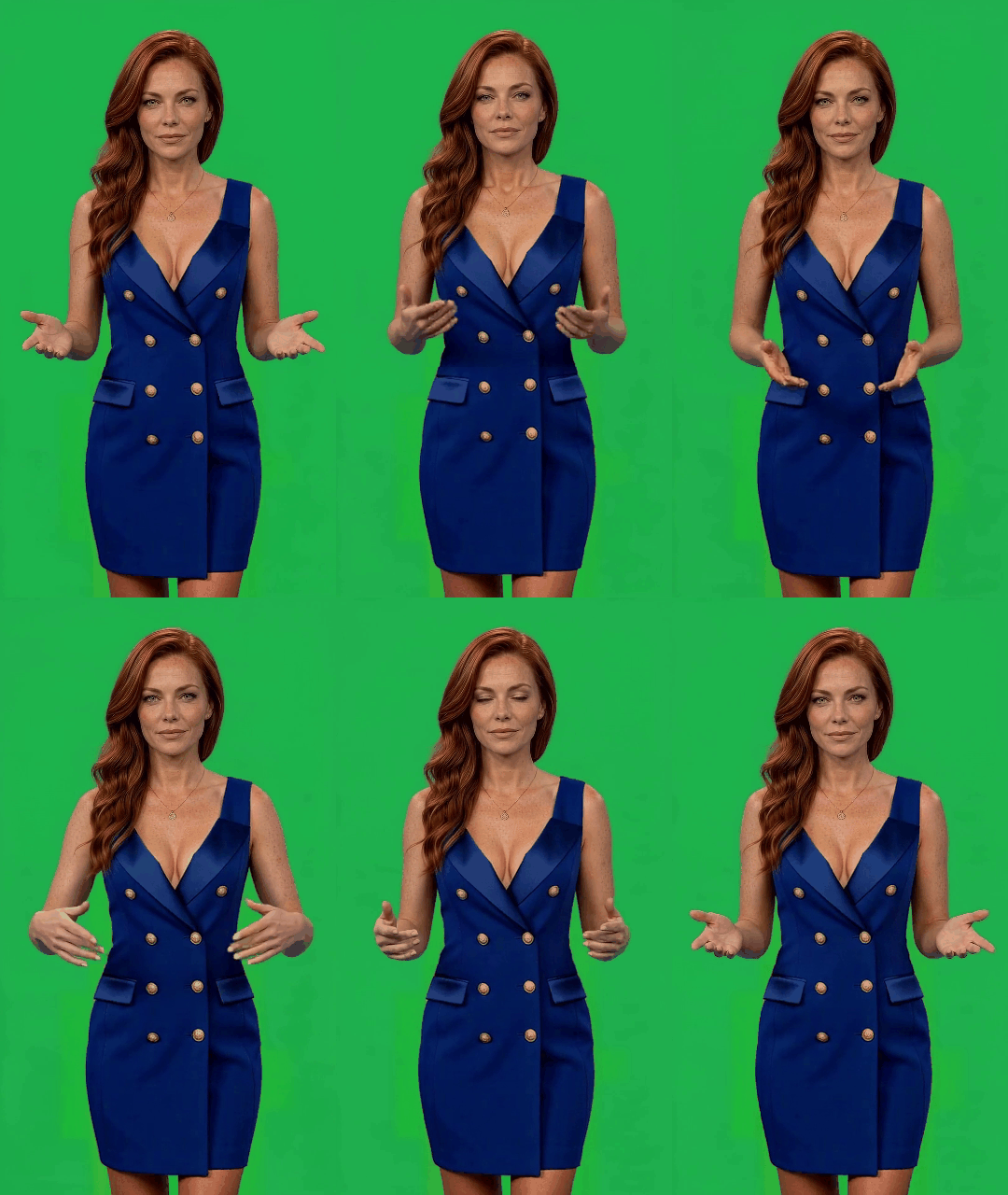 Click to zoomMiniMax Base 20-Step Preview
7. Conclusion & Next Steps#
With the validation of MiniMax H3 ref2va + TaoMate 2-Step LoRA + SAM3 Decimation, Ruby NewsStudio now possesses a sub-minute video wardrobe transformation engine that completely preserves anchor identity, motion dynamics, and speech synchronization.
Our next engineering milestones:
- Wardrobe Asset Library Generation: Systematically cataloging 3-view blueprints across executive suits, cocktail attire, seasonal outerwear, and newsroom jackets.
- Hairstyle & Persona Inpainting Validation: Testing open-vocabulary SAM3 prompts on anchor facial and hair regions.
- Automated Pipeline Worker Integration: Exposing
job_type: "wardrobe_inpaint"inworkers/pipeline-worker/to allow news editors to re-dress anchors with a single click from the Newsroom dashboard.