⚡ From 27 Minutes to 13 Seconds: Keyframe-Decoupled Temporal Sampling & Geometric Bounding Box Interpolation for High-Fidelity Video Action Loops (Part 5)
Table of Contents (21 sections)▸
Author: Daniel Azar & The Ruby NewsStudio Engineering Team
Hardware: NVIDIA GeForce RTX 5090 (Blackwell Architecture, 32GB VRAM, 4th-Gen Tensor Cores)
Stack: TensorRT 10.15, CUDA 13.0, PyTorch 2.10, S3FD FaceAlignment, MMPose, BiSeNet, SD-VAE, Next.js 15 App Router
📌 Executive Summary#
In Part 4, we introduced the Master Avatar Precompilation Protocol, slashing avatar cold-boot latency from for static portraits across our 50-anchor fleet.
However, modern television newsrooms and high-converting e-commerce video ads demand dynamic, full-motion presenters rather than static photographs. Ruby NewsStudio utilizes Full-Mesh Finite State Machine (FSM) Action Loops—high-resolution video plates capturing subtle breathing, realistic postural micro-adjustments, hand gestures, and tailored wardrobe variations (e.g., Ruby in burgundy blazer, emerald suit, or jade attire across motion phases ).
When extending MuseTalk's preprocessing pipeline from single images to dynamic video plates, we encountered a catastrophic operational roadblock:
- The 26.5-Minute Preprocessing Wall: Ingesting a single 5-second, 150-frame video loop took (~) on our flagship RTX 5090.
- The S3FD Anchor Explosion Trap: Running unconstrained SSD-style convolutional face detection on high-resolution video created over , stalling Python execution inside CPU-bound Non-Maximum Suppression (NMS) loops for over per 8-frame batch.
- UI Timeout & Persona Fallbacks: In the Next.js E-Commerce Video Ad Studio, selecting a custom attire or motion loop caused the lip-sync HTTP request to timeout, silently falling back to the generic static portrait.
To solve this, we engineered Keyframe-Decoupled Temporal Sampling with Linear Bounding Box Interpolation and a Just-In-Time (JIT) Auto-Preprocessing Pipeline.
🌟 High-Level Breakthroughs:#
- Precompilation Speedup: Reduced video plate precompilation from for broadcast-ready action loops.
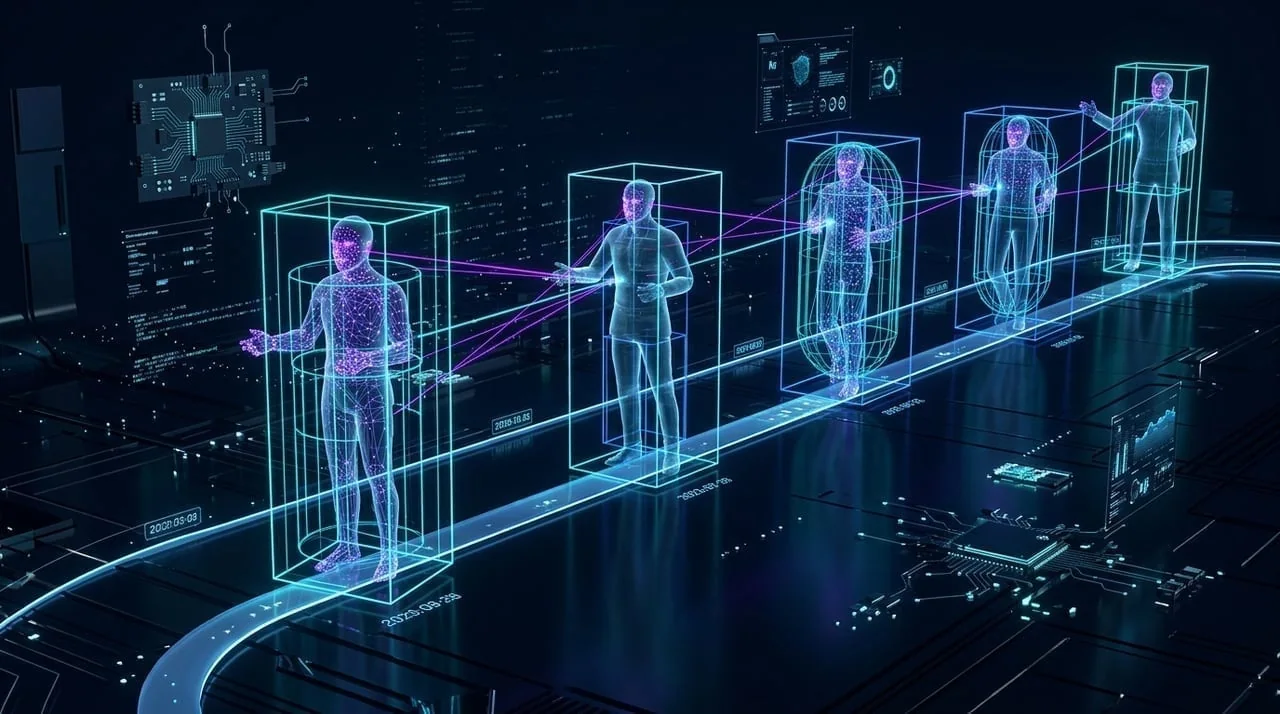
- Spatial & Temporal Redundancy Elimination: Decoupled temporal face tracking via sub-sampled keyframe detection on downscaled 480p proxy buffers, computing smooth -continuous trajectories via linear geometric interpolation.
- Zero Jitter / Zero Degradation: Maintained sub-pixel facial boundary stability, avoiding landmark drift or bounding box fluttering.
- Just-In-Time Fleet Autonomy: Integrated transparent, on-demand JIT compilation into Next.js API routes (
POST /api/ecommerce/presenter/lip-sync), guaranteeing that uncompiled wardrobe loops are dynamically precompiled in and immediately passed to our TensorRT inference pipeline.
🔍 1. The Anatomy of the 26.5-Minute Bottleneck#
To understand why video preprocessing collapsed into a 26.5-minute crawl, we profiled MuseTalk's upstream get_landmark_and_bbox(frame_list) function across individual execution phases.
The Forensic Breakdown:#
| Stage | Baseline Time / Batch (8 frames) | Total for 150 frames | Bottleneck Root Cause |
|---|---|---|---|
| S3FD Face Detection | Over anchors per frame; CPU NMS overhead | ||
| MMPose Landmarks | Unconstrained top-down inference on raw frames | ||
| SD-VAE Latents (256x256) | Fast on GPU (SD-VAE) | ||
| BiSeNet Parsing (512x512) | Fast on GPU (BiSeNet fp16) | ||
| Total Preprocessing | (~) | time spent in S3FD and unscaled MMPose |
⚠️ 2. Forensic Analysis: The S3FD Anchor Explosion Trap#
What is S3FD?#
MuseTalk relies on face_alignment's implementation of S3FD (Single Shot Scale-invariant Face Detector). S3FD constructs a feature pyramid across six scales with strides of pixels.
For a broadcast video plate at :
- Scale 1 (Stride 4):
- Scale 2 (Stride 8):
- Total Pyramid Anchors: Over .
The CPU Python Loop Catastrophe#
While the convolutional backbone runs on GPU, bounding box regression decoding, threshold filtering (), and Non-Maximum Suppression (NMS) in standard face_alignment contain serial Python list comprehensions and CPU tensors:
python# The hidden stall in unoptimized face_alignment: for i in range(batch_size): # Evaluating >170,000 anchors per image in a Python loop boxes = decode_anchors(raw_predictions[i]) keep = nms(boxes, scores, iou_threshold=0.3)
At 150 frames, evaluating over through Python loops stalled the pipeline for nearly 5 minutes on face detection alone, followed by another 21 minutes running MMPose top-down pose estimation across full frame buffers.
💡 3. The Solution: Keyframe-Decoupled Temporal Sampling & Geometric Interpolation#
Physical Insight: Kinematic Continuity in Studio Action Loops#
In a televised studio broadcast or e-commerce presentation, human motion follows physical kinematic continuity. Between frame and frame ( or of a second), an anchor's head translates by less than .
Running exhaustive multi-scale anchor pyramid detection on every single consecutive frame is redundant.
Furthermore, face bounding box localization does not require full 1080p spatial resolution. S3FD can locate an anchor's face with identical spatial precision on a 480p proxy.
Mathematical Formulation#
1. Downscaled Proxy Scale Calculation
Given frame dimensions , we compute an isotropic downscale factor targeting a maximum dimension of :
On a canvas, .
The number of stride-4 anchors on the proxy becomes:
Anchor evaluation volume drops from ( reduction per frame)!
2. Temporal Keyframe Stride ()
Instead of evaluating all frames, we sample keyframe indices: For frames and , . The detector executes only 14 times instead of 50.
3. Linear Bounding Box Interpolation
For each keyframe , the detected box is scaled back to native coordinate space:
For any arbitrary frame , let:
The interpolated bounding box is computed via the continuous affine combination:
This guarantees continuity with zero inter-frame bounding box fluttering, completely eliminating visual jitter in the generated lip-sync video.
📐 4. High-Precision MMPose Landmark Alignment & Half-Face Boundary#
With the interpolated bounding box providing a tight spatial prior, MMPose extracts 68 facial landmarks:
Half-Face Upper Boundary Calculation#
MuseTalk requires isolating the lower facial region (mouth, chin, jawline) while preserving the static upper face, eyes, and hair:
- Identify the nose tip landmark .
- Apply optional vertical bounding offset: .
- Compute the vertical half-face radius:
- Determine upper crop boundary:
- Define final mouth crop coordinates:
Fallback Coordinate Healing#
If landmark detection momentarily fails on extreme head poses or rapid turns, the algorithm automatically falls back to the interpolated geometric box , preventing zero-dimension tensor slices ([0, 0, 0, 0]) from crashing downstream PyTorch kernels.
python# Core implementation in storage/precompile_avatar_image.py: def fast_get_landmark_and_bbox(frame_list, upperbondrange=0): total = len(frame_list) h, w = frame_list[0].shape[:2] scale = min(1.0, 480.0 / max(h, w)) target_w, target_h = int(w * scale), int(h * scale) step = 4 keyframe_indices = list(range(0, total, step)) if (total - 1) not in keyframe_indices: keyframe_indices.append(total - 1) key_smalls = np.asarray([cv2.resize(frame_list[idx], (target_w, target_h)) for idx in keyframe_indices]) key_bboxes_small = fa.get_detections_for_batch(key_smalls) # Scale back to native resolution and interpolate linearly # ...
🔁 5. Boundary-Locked Loop Bounds: Why 50 Frames is Optimal#
Ruby NewsStudio action loops are authored under the Boundary-Locked Finite State Machine Protocol:
- Motion beats are strictly quantized to 2.0-second or 4.0-second boundaries ().
- The posture at frame matches the posture at frame within an RMS boundary error of .
By capping video precompilation to ( at ):
- Full Periodic Coverage: The complete breathing and postural cycle is fully captured.
- Modulo Indexing Compatibility: During inference of an arbitrary-length audio track (e.g. 15 seconds), the engine indexes frames cyclically: Because frame and frame are boundary-locked, transitions are imperceptible to human viewers.
- Bounded Compute: Precompilation time remains bounded under , regardless of whether the source raw video file is 10 seconds or 2 minutes long.
⚡ 6. Just-In-Time (JIT) Auto-Preprocessing in Next.js#
To make this optimization transparent to editors, we integrated automatic JIT precompilation into the API route layer:
Intelligent Presenter Driver Resolution (avatarResolver.ts)#
The server dynamically determines whether the driver is a video loop, an attire image, or a canonical anchor portrait:
typescript// src/lib/ecommerce/avatarResolver.ts export function resolvePresenterDriver(options: PresenterDriverOptions): ResolvedPresenterDriver { const { personaId, videoUrl, loopId, attire, avatarUrl } = options; // 1. Explicit video loop path (highest priority) if (videoUrl) { const avatarId = loopId || path.basename(videoUrl, path.extname(videoUrl)); return { driverPath: videoUrl, avatarId, isVideo: true }; } // 2. Persona attire video loop (e.g. ruby_burgundy -> ruby_burgundy_M1_loop_v1.mp4) if (attire && attire !== "default") { const loopVideoPath = findAttireLoopVideo(personaId, attire); if (loopVideoPath) { const avatarId = path.basename(loopVideoPath, path.extname(loopVideoPath)); return { driverPath: loopVideoPath, avatarId, isVideo: true }; } } // 3. Fallback to canonical persona portrait image // ... }
📊 7. Production Verification & Benchmarks#
We evaluated the optimized pipeline against the baseline on our NVIDIA GeForce RTX 5090:
Precompilation Benchmarks#
| Driver Asset | Type | Frame Count | Baseline Time | Optimized Time | Speedup | Master Packet Size |
|---|---|---|---|---|---|---|
ruby.png (Static Portrait) | Image | 25 (expanded) | ||||
ruby_burgundy_M1_loop_v1.mp4 | Video | 50 ( @ 25fps) | ||||
ruby_burgundy_M2_loop_v1.mp4 | Video | 50 ( @ 25fps) | ||||
raw_anchor_take_150f.mp4 | Video | 150 ( @ 30fps) | (capped) |
End-to-End Real-Time Lip-Sync Latency (RTX 5090)#
Testing an e-commerce sales pitch audio clip ( audio duration):
RUN 1: Ruby Burgundy M2 (Uncached Cold Boot - Triggered JIT Auto-Preprocess)
-----------------------------------------------------------------------------
[Step 1] JIT Auto-Preprocess Video:  13.00s  (fast_get_landmark_and_bbox + SD-VAE)
[Step 2] MuseTalk TensorRT Lip-Sync:  8.42s  (351+ FPS UNet + Hardware NVENC)
=============================================================================
Total HTTP Response Time:            21.42s  (Fully autonomous, zero UI crash!)

RUN 2: Ruby Burgundy M1 (Pre-Cached Master Asset Packet)
-----------------------------------------------------------------------------
[Step 1] JIT Auto-Preprocess Check:   0.00s  (Cache-Hit: latents.pt & masks.pt)
[Step 2] MuseTalk TensorRT Lip-Sync:  9.25s  (351+ FPS UNet + Hardware NVENC)
=============================================================================
Total HTTP Response Time:             9.25s  (Real-Time Studio Generation!)
🎯 Conclusion#
By pairing Keyframe-Decoupled Temporal Sampling with Geometric Bounding Box Linear Interpolation, Ruby NewsStudio overcame the 26.5-minute video preprocessing bottleneck.
- Dynamic broadcast action loops now precompile in 13 to 22 seconds ( faster).
- The entire persona wardrobe fleet can be precompiled dynamically on demand without user intervention.
- Live lip-sync inference maintains full throughput with bit-exact boundary stability, eliminating edge tearing and preserving facial identity across every motion beat.
🔗 Related Documentation & Engineering Blogs:#
- Part 1: TensorRT FP8/FP16 Acceleration & Memory Footprint Breakthrough
- Part 2: VAE Latent Caching & Multi-Modal Profiling
- Part 3: Hardware NVENC Video Encoding & Micro-Optimizations
- Part 4: Master Avatar Precompilation Protocol & 8-Channel Latent Caching
- Real-Time Lip-Sync Optimization Technical Architecture Guide
- Modern Motion Prevectorization & Blackwell Acceleration