
Molten AI Agent: Master's Thesis on Autonomous Business Analysis & Recursive Agile Task Decomposition
Table of Contents (8 sections)▸
One of the most persistent bottlenecks in software engineering happens before a single line of application code is written: translating a high-level product idea into a structured, accurately estimated, cross-functional engineering backlog.
For my MBA Master's Thesis (completed in July 2025 under the MoltenMinds umbrella), I conducted empirical market research with software engineers, project managers, tech leads, and business analysts, and built Molten AI Agent (molten-ai-agent)—an AI-powered task automation web platform that takes raw project concepts and "melts" them down into structured specifications, role-assigned tasks, recursively decomposed Epics, and prioritized micro-checklists on an interactive Kanban board.
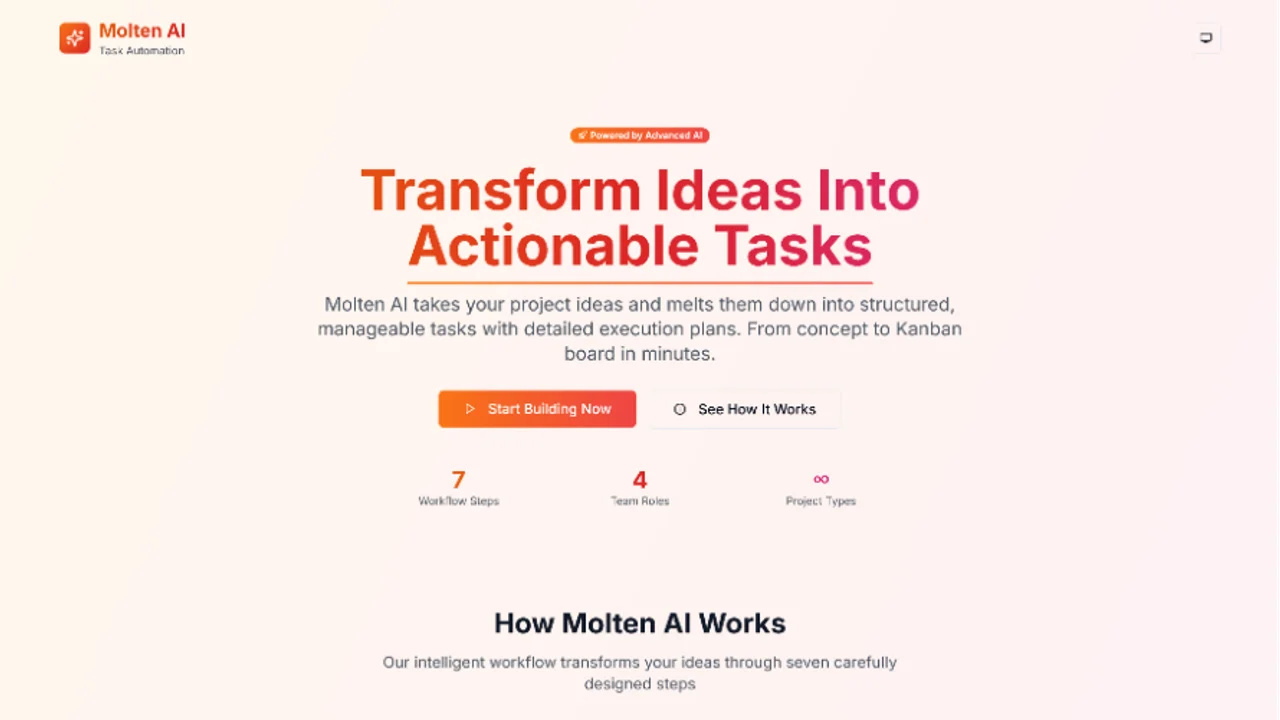 Click to zoomMolten AI Task Automation — Landing Page & 7-Step Workflow
1. Empirical Market Research: Quantifying the Planning Bottleneck#
Before designing the product architecture, Chapter 3 of the thesis surveyed 38 industry professionals (>60% with 6+ years of experience in technology projects; ~50% software engineers/developers and >35% PMs, Tech Leads, and Business Analysts):
- Agile Dominance (~90%): Nearly 90% of surveyed teams operate under Scrum, Kanban, or hybrid Agile methodologies, with Jira used by ~2 out of every 3 respondents.
- Low Satisfaction with Manual Task Breakdown (~60%): Nearly 60% of respondents rated their satisfaction with current task planning and breakdown processes as neutral-to-very-low (scores 1–3 out of 5), with only 10.8% "very satisfied".
- High Time Cost (46% spend >25% of planning time): Over 70% of respondents dedicate more than 10% of their total planning time strictly to initial epic and task breakdown—and 46% spend more than 25% of their planning time on this manual translation step.
- Core Pain Points ("Vocabulary of Pain"): The top three reported challenges were time consumption, lack of clarity in requirements, and human estimation/omission errors.
- Strong Product-Market Validation (>75%): More than 75% of surveyed professionals rated an AI-assisted task decomposition and enrichment tool as "Valuable" or "Extremely Valuable" (scores 4 and 5).
2. Architectural Overview: The 7-Stage Guided & Autonomous Pipeline#
Rather than treating backlog generation as a single one-shot LLM prompt—which produces shallow checklists and erodes user trust—Molten AI Agent structures the workflow into seven explicit stages with a live header toggle between Manual Control (review and approve each step) and Autonomous Mode:
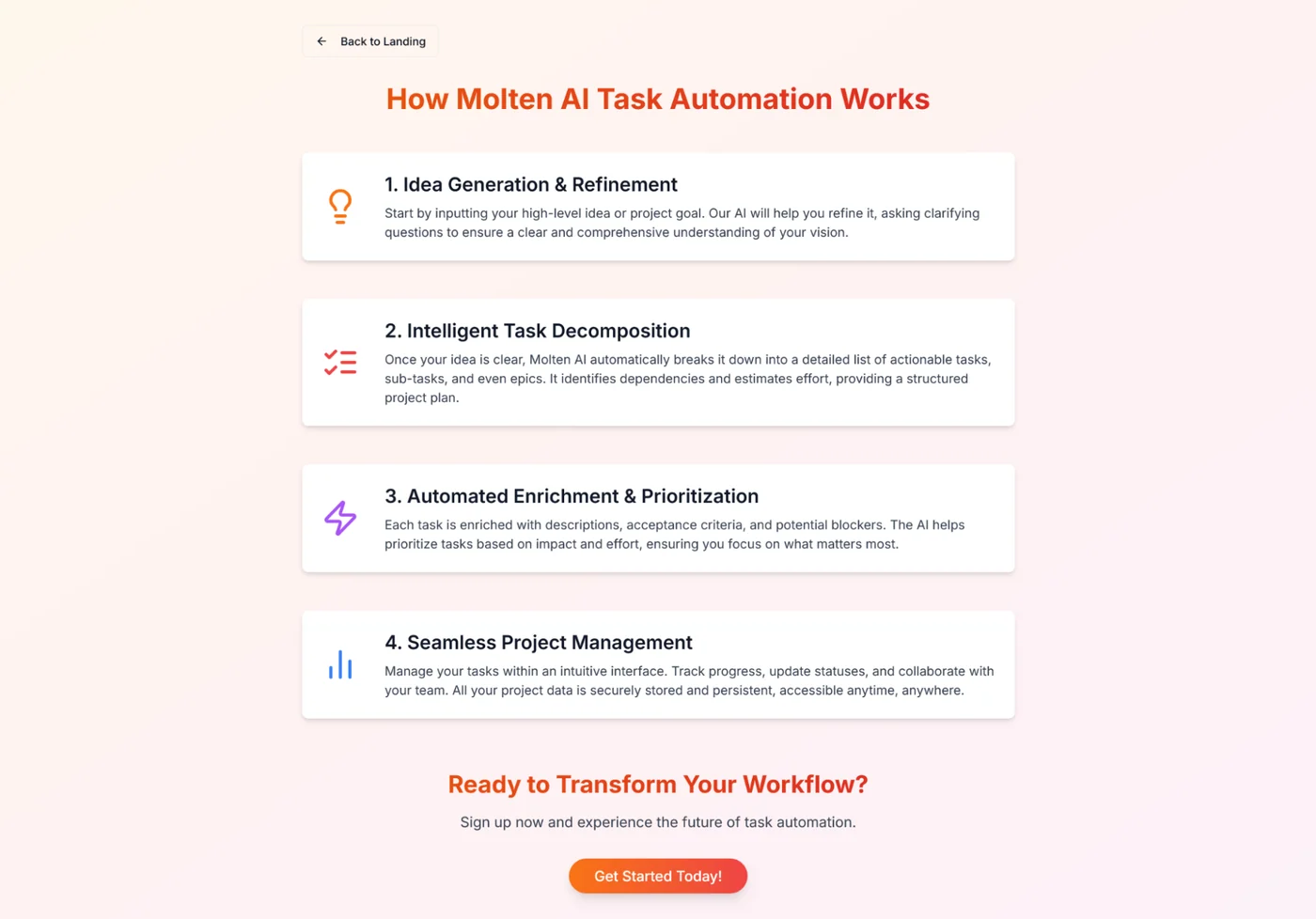 Click to zoomHow Molten AI Task Automation Works
Multi-Project Persistence Dashboard#
Authenticated users land on the Project Control Dashboard backed by Supabase PostgreSQL with Row-Level Security (RLS), allowing teams to create new initiatives or resume existing projects at their exact workflow stage:
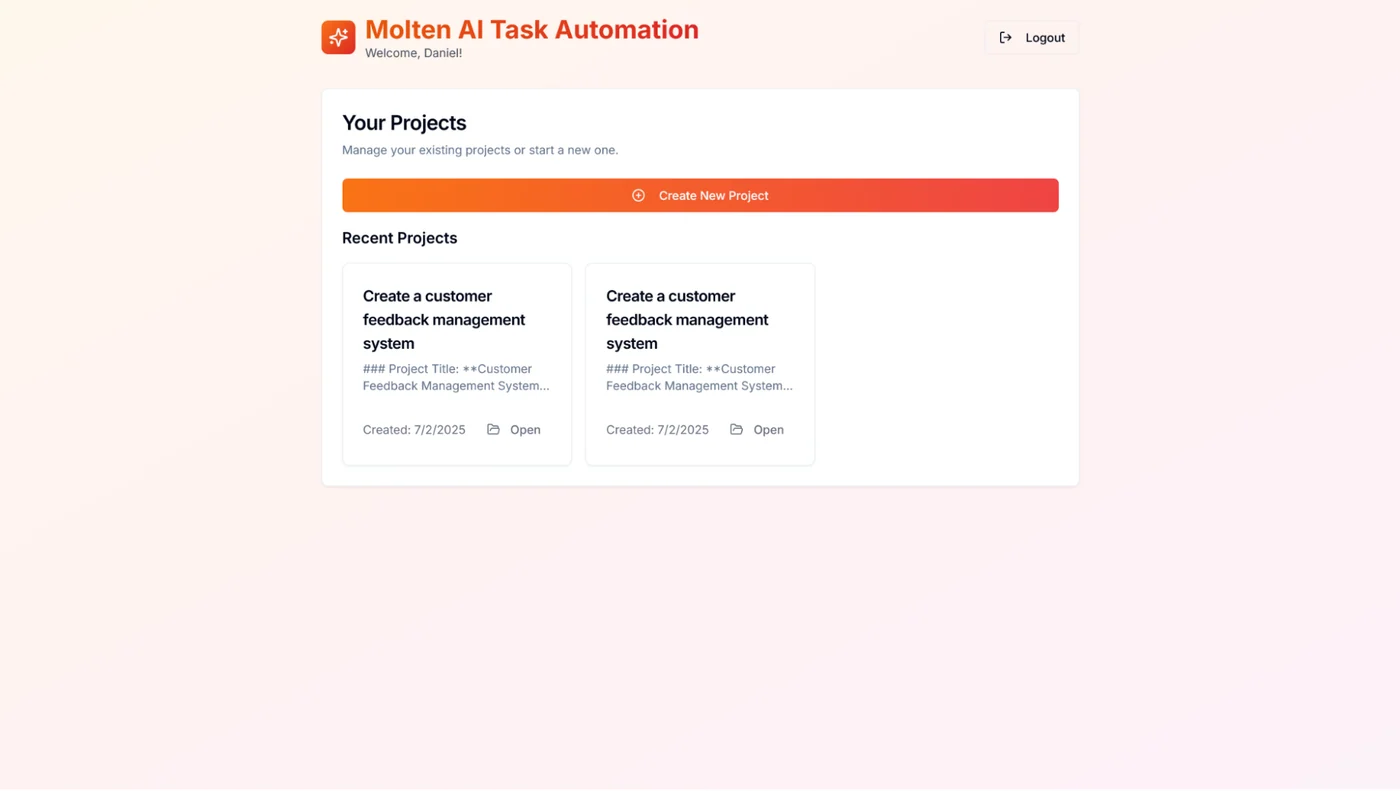 Click to zoomMolten AI — Project Control Dashboard
3. Stages 1 & 2: Idea Intake & AI Business Analyst Refinement#
In Stage 1 (Idea Input), the user describes their project in natural language—for example, "Create a customer feedback management system":
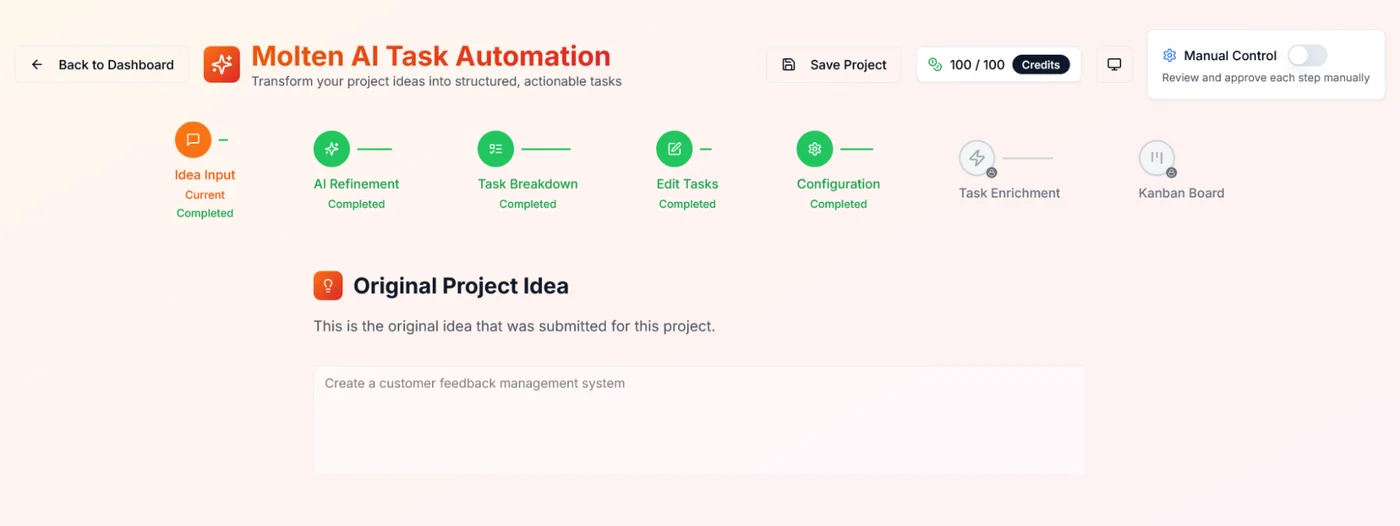 Click to zoomStage 1 — Original Project Idea Input
In Stage 2 (AI Refinement — /api/refine-idea), the agent acts as a Senior Business Analyst, transforming the raw sentence into a structured specification covering:
- Project Title (Customer Feedback Management System — CFMS)
- Main Objective and Business Value
- Key Features & Components (Multi-Channel Feedback Collection, Centralized Repository, Real-Time Analytics Dashboard, Automated Response System, Reporting & Insights)
- Target Users / Stakeholders (Customers, Support Team, Product Development, Marketing, Management)
- Measurable Success Criteria & Expected Outcomes (NPS lift, response rate, churn reduction)
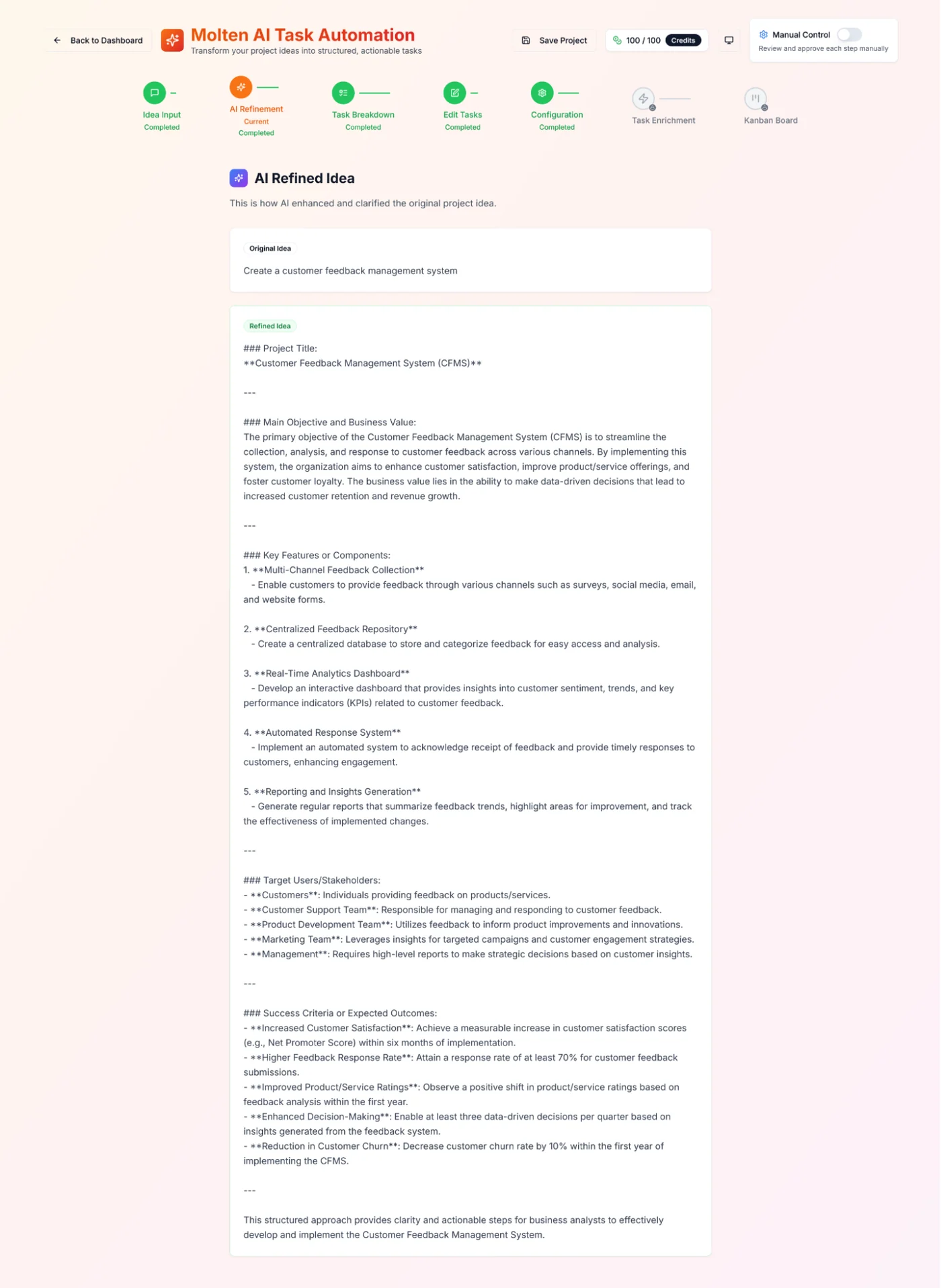 Click to zoomStage 2 — AI Refined Business Analyst Specification
4. Stages 3 & 4: Schema-Enforced Role Breakdown & Interactive Task Editor#
Once the refined brief is approved, Stage 3 (Task Breakdown — /api/generate-tasks) uses the Vercel AI SDK (generateObject) with strict Zod schemas to synthesize cross-functional tasks across four specialized team roles (developer, designer, qa, and product-manager), complete with Fibonacci effort estimates (1, 2, 3, 5, 8, 13, 21), domain tags, and explicit inter-task dependencies (Dependencies: developer-002, etc.):
typescriptconst taskSchema = z.object({ tasks: z.array( z.object({ id: z.string(), title: z.string(), summary: z.string(), effort: z.number(), // Fibonacci scale: 1, 2, 3, 5, 8, 13, 21 role: z.enum(["developer", "designer", "qa", "product-manager"]), tags: z.array(z.string()), dependencies: z.array(z.string()), status: z.enum(["todo", "in-progress", "review", "done"]).default("todo"), }), ), })
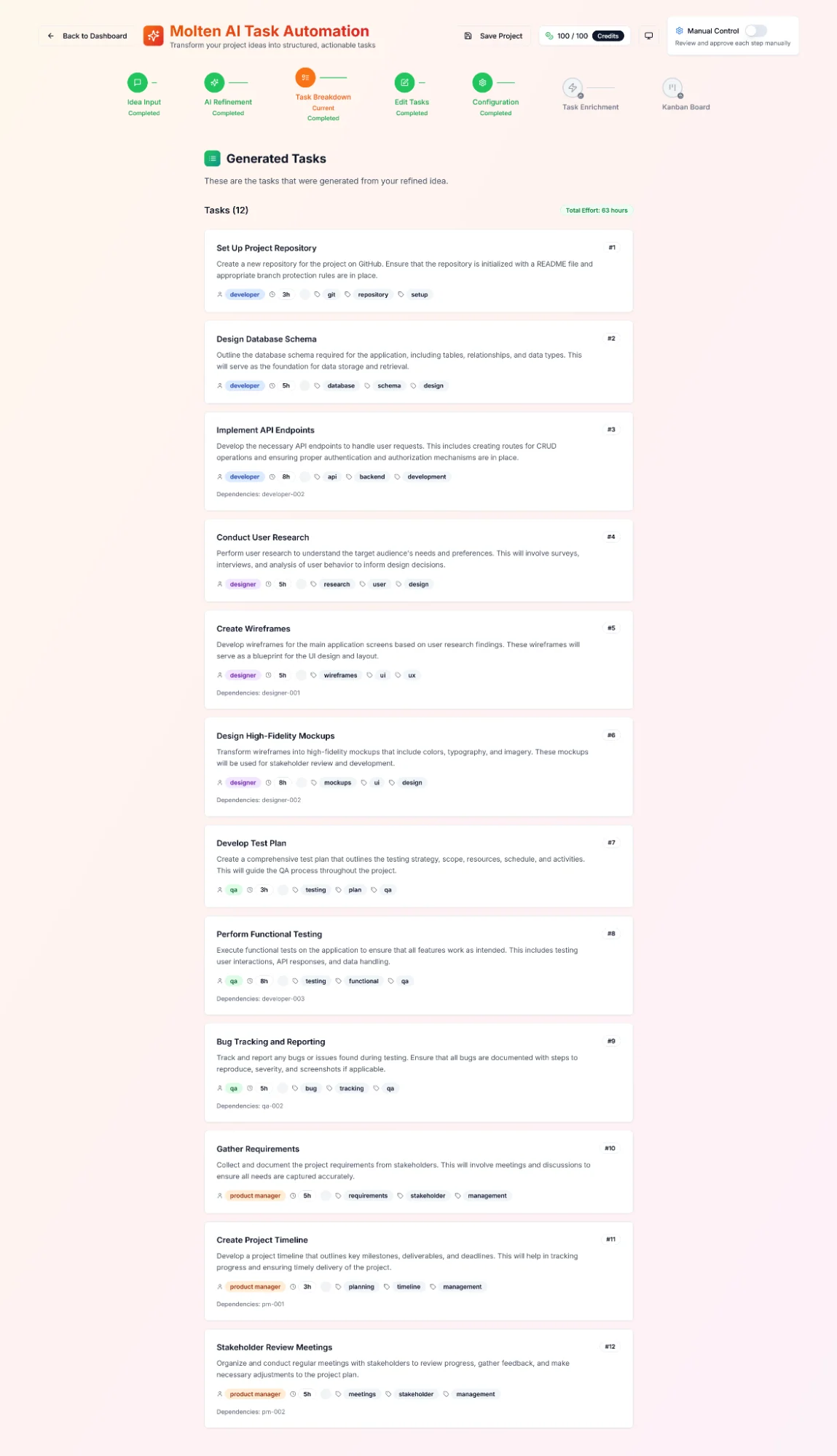 Click to zoomStage 3 — Generated Role-Based Tasks with Fibonacci Effort & Dependencies
Directly addressing the market survey's top concern around AI accuracy and human control, Stage 4 (Edit Tasks) lets users review, customize, add, or prune any generated task before committing API credits to deep enrichment.
5. Stages 5 & 6: Credit-Gated Governance & Recursive Epic Decomposition#
Because recursive LLM calls can multiply token costs, Stage 5 (Enrichment Configuration) introduces explicit Credit & Complexity Governance:
- Enrichment Presets: Choose between Skip Enrichment (
0 credits), Light Enrichment (~6 credits, basic decomposition only), or Full Enrichment (~18 credits, complete decomposition + micro-todo generation). - Fibonacci Complexity Threshold: Tasks with effort the selected Fibonacci threshold (default: 8 points) are flagged as too complex for a single sprint and automatically decomposed into an Epic with 3–5 smaller sub-tasks.
- Maximum Iterations Cap: Bounds the recursion depth (e.g.,
3 iterations) to prevent infinite decomposition loops while displaying live estimated credits, cost, and processing time.
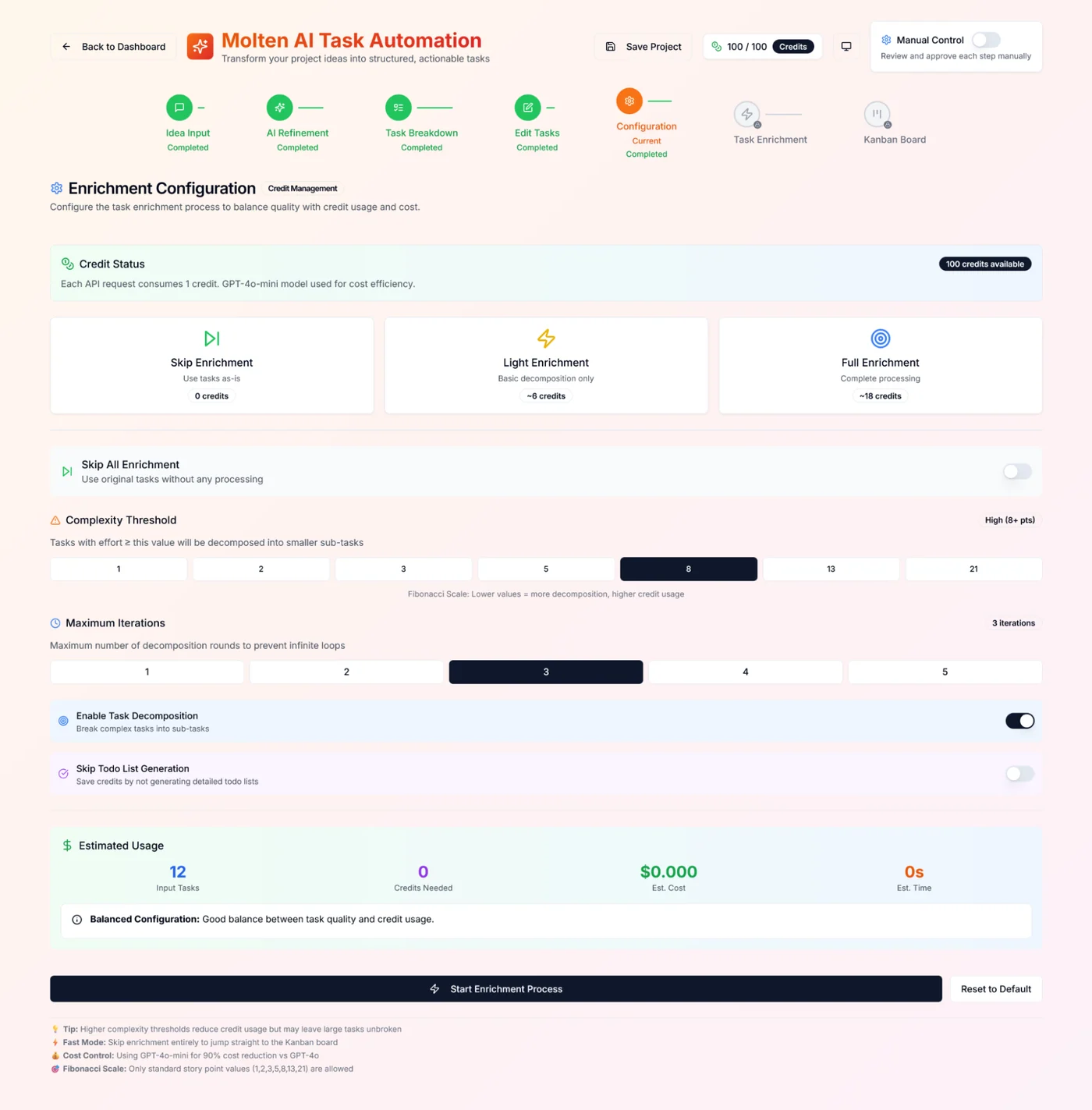 Click to zoomStage 5 — Enrichment Configuration, Complexity Threshold & Credit Budget
During Stage 6 (Task Enrichment), /api/decompose-to-epic and /api/enrich-task-advanced iterate over the backlog:
- Every task points is promoted to an Epic and split into 3–5 independently deliverable sub-tasks ( points).
- Each atomic task is enriched with role-specific acceptance criteria, Definition of Done, and a prioritized 5–8 item todo checklist where each action item is scoped to 15–60 minutes.
6. Stage 7: Enhanced Kanban Board & Real-Time Project Analytics#
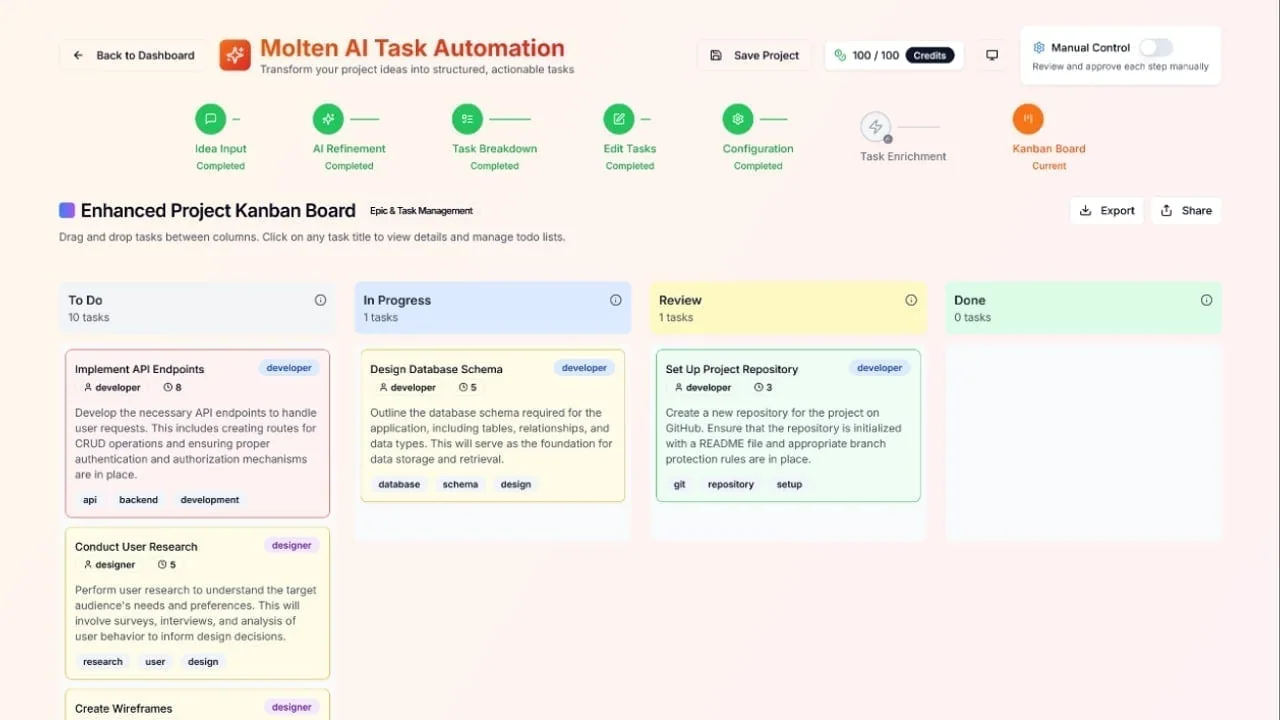
Finally, the enriched backlog is rendered on the Enhanced Project Kanban Board (To Do, In Progress, Review, Done) with drag-and-drop status transitions, export/share actions, and a live Project Statistics & Real-Time Analytics dashboard tracking total tasks, story points, active epics, estimated working days, and role/priority distributions:
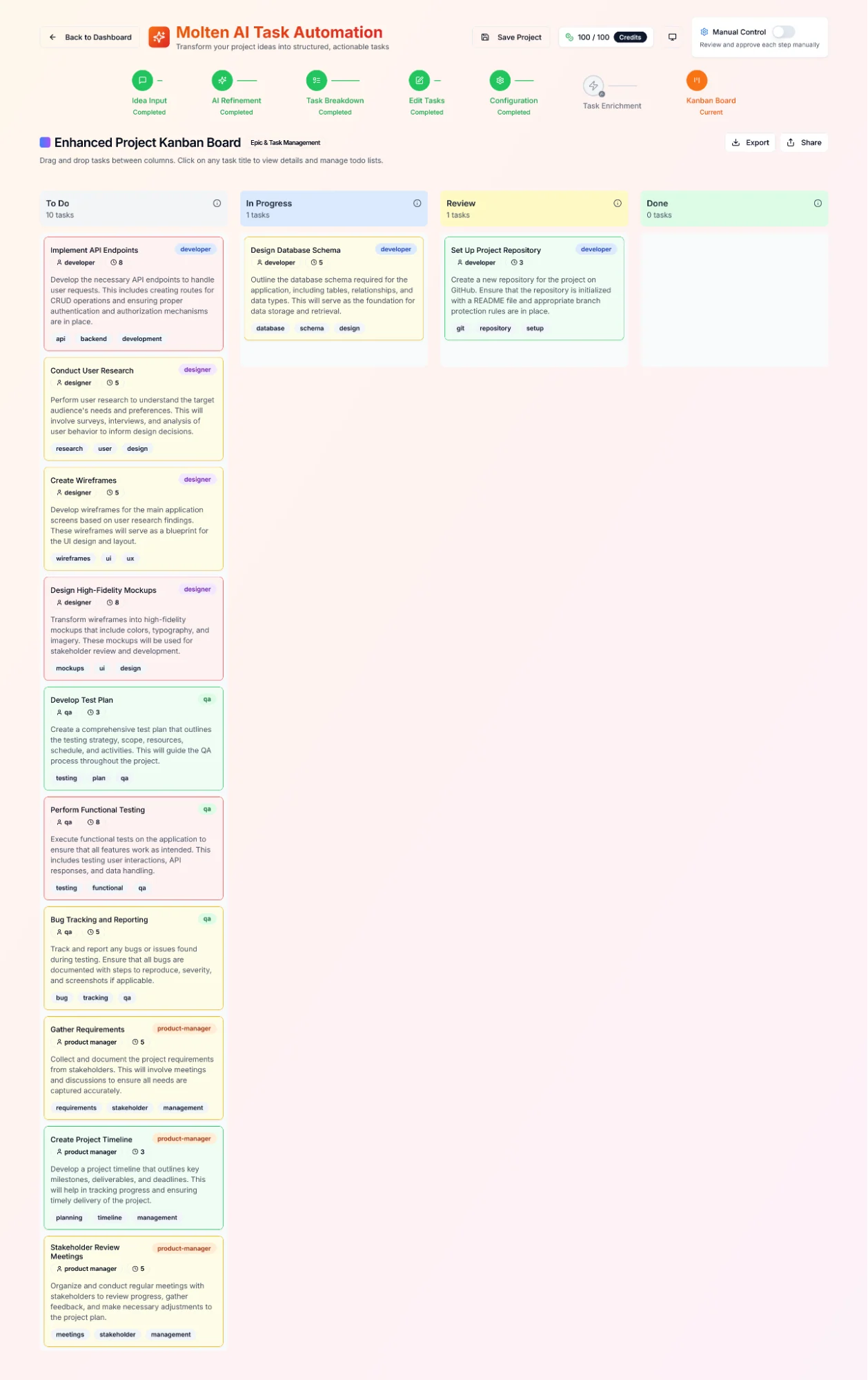 Click to zoomStage 7 — Enhanced Project Kanban Board
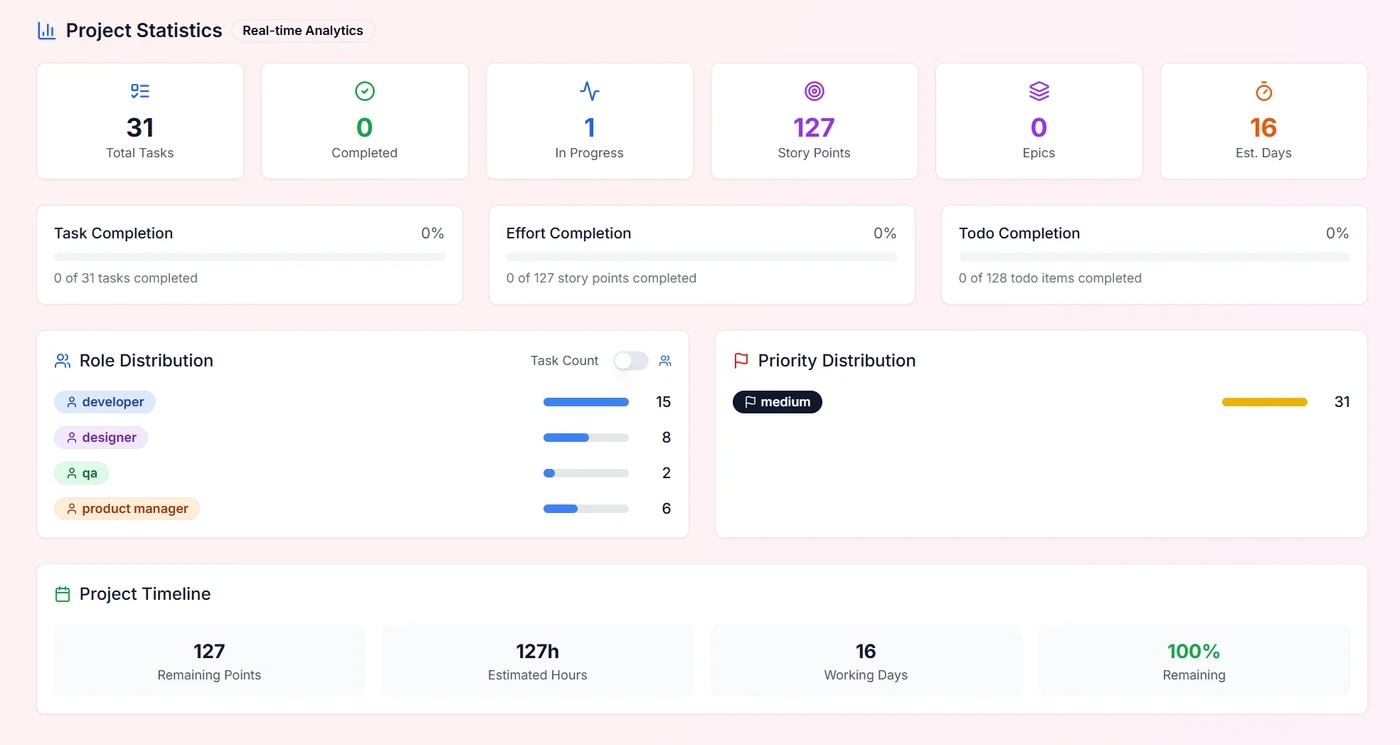 Click to zoomReal-Time Project Statistics, Role Distribution & Timeline Analytics
Links & Resources#
- GitHub Repository: github.com/daniazar/molten-ai-agent
- Consultancy: MoltenMinds (moltenminds.com)