
Molten AI Agent Deep-Dive: Recursive Fibonacci Task Decomposition & Multi-Stage Context Enrichment
Table of Contents (6 sections)▸
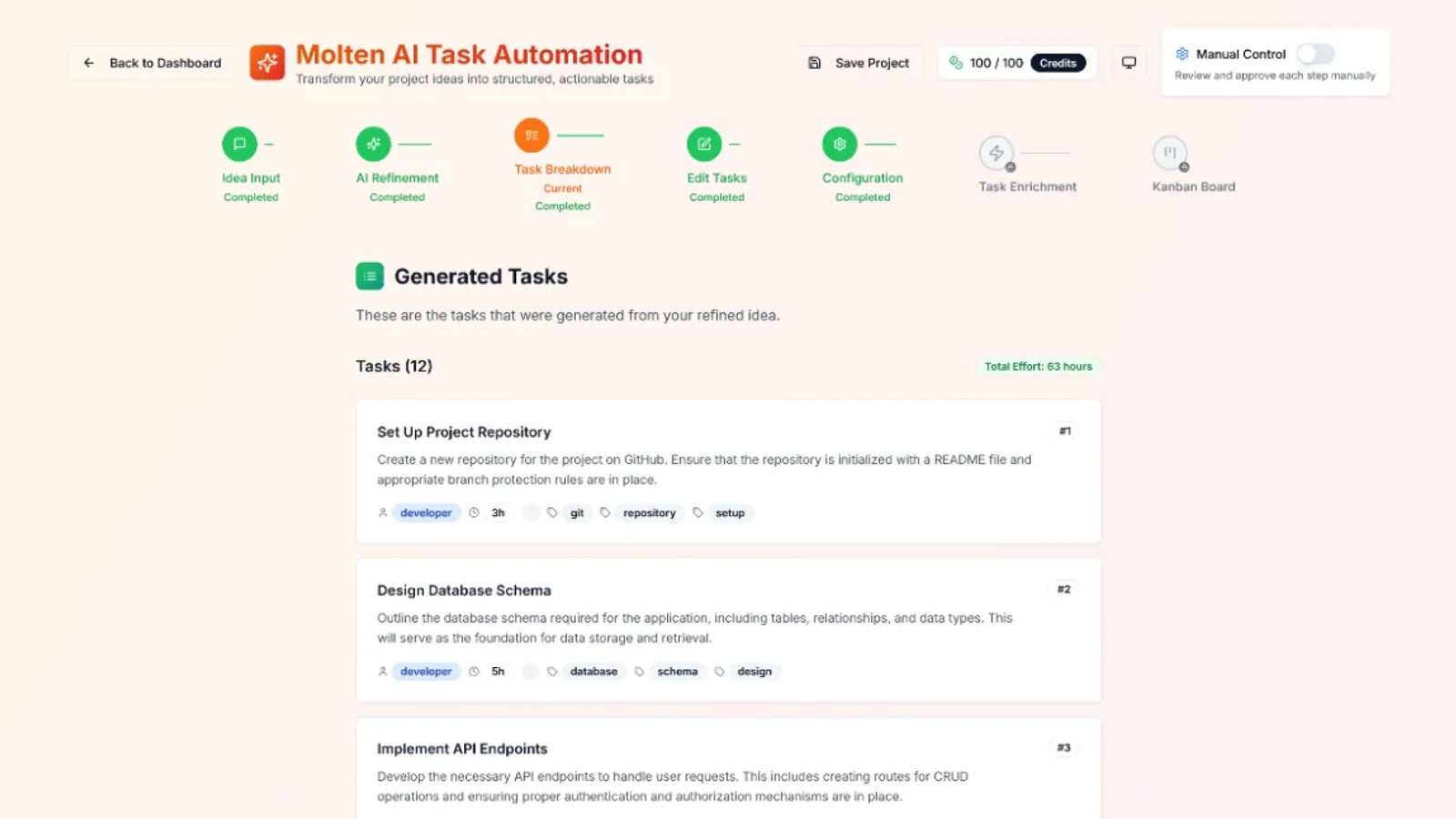
In my MBA Master's Thesis overview of Molten AI Agent, I shared the empirical results and product workflow of our 7-stage autonomous Business Analyst & Project Management system.
In this follow-up technical post, I want to look directly at the TypeScript API routes and Zod schema pipelines (app/api/generate-tasks/route.ts, app/api/enrich-task-advanced/route.ts, app/api/decompose-task/route.ts, and app/api/decompose-to-epic/route.ts) that solved the hardest engineering problem in the thesis: preventing "Single-Prompt Scope Collapse" when LLMs estimate and decompose software architectures.
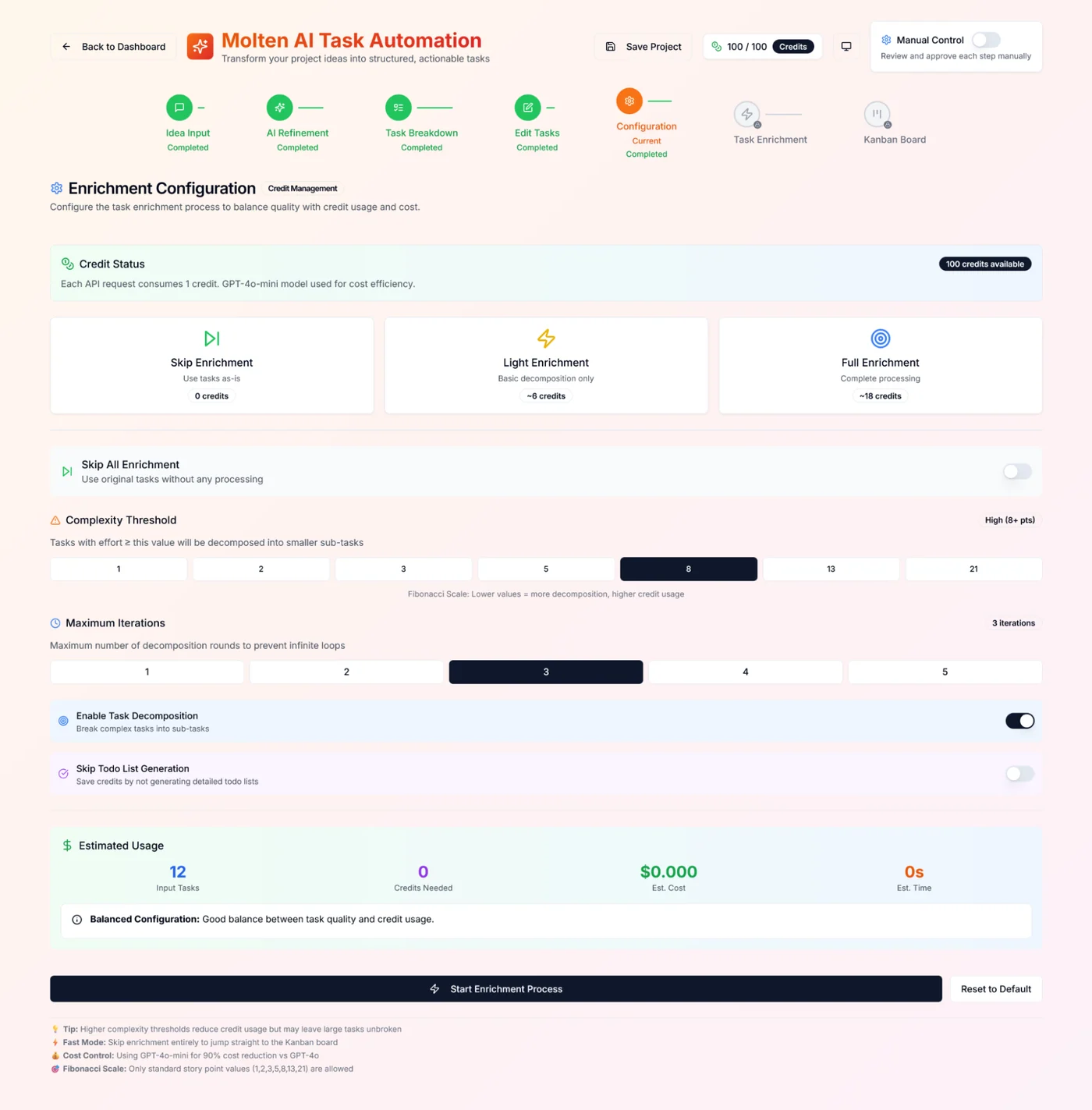 Click to zoomMolten AI Agent — Customizable Multi-Dimensional Task Enrichment Pipeline
1. The Failure Mode of Single-Shot LLM Backlog Generation#
When you ask a frontier LLM in a single prompt to "Generate a complete Agile backlog for a multi-tenant SaaS application", it consistently exhibits three failure modes:
- Granularity Collapse: It mixes trivial 1-hour tasks ("Create login button") alongside massive multi-week epics ("Build payment & billing engine") at the same flat hierarchy level.
- Unbounded Story Point Inflation: Without strict schema constraints, the model invents non-Fibonacci numbers (
4,6,10,15points) or assigns5 pointsto a task that actually hides four distinct backend, frontend, database, and security sub-projects. - Context Starvation in Acceptance Criteria: Because output token budgets are finite, generating 20 tasks in one call forces the model to write generic 1-line descriptions instead of concrete technical specifications, data models, and edge cases.
To eliminate these failure modes, we split backlog synthesis into four orthogonal, Zod-enforced API stages.
2. Enforcing Fibonacci Invariants with Strict Zod Schemas (/api/generate-tasks)#
In app/api/generate-tasks/route.ts, we use the Vercel AI SDK's generateObject with a strict TaskSchema that constrains both the role taxonomy and the Fibonacci story point scale:
typescriptconst TaskSchema = z.object({ title: z.string().describe("Clear, concise task title"), description: z.string().describe("Detailed description of what needs to be done"), category: z.enum([ "Frontend", "Backend", "Database", "Design", "Testing", "DevOps", "Research", "Integration", ]), priority: z.enum(["High", "Medium", "Low"]), storyPoints: z .number() .int() .refine((val) => [1, 2, 3, 5, 8, 13, 21].includes(val), { message: "Story points must follow the Fibonacci sequence (1, 2, 3, 5, 8, 13, 21)", }), acceptanceCriteria: z .array(z.string()) .min(2) .max(5) .describe("Testable acceptance criteria"), dependencies: z.array(z.string()).describe("Other task titles this depends on"), risks: z.array(z.string()).describe("Technical or delivery risks"), });
Crucially, the system prompt explicitly calibrates the model's estimation scale so complex architectural modules are intentionally assigned 8, 13, or 21 points rather than being artificially compressed into a 5:
1–2 pts: Simple CRUD endpoint or UI component with zero external dependencies.3–5 pts: Multi-component feature completable within a single sprint by one engineer.8–21 pts: Cross-cutting architectural subsystem that must be routed to the recursive decomposition engine.
3. Configurable 10-Dimension Task Enrichment (/api/enrich-task-advanced)#
Before decomposing or executing a task, the engineer or product manager configures the Enrichment Matrix (components/enrichment-settings.tsx and app/api/enrich-task-advanced/route.ts).
Instead of bloating every ticket with boilerplate, enrich-task-advanced dynamically constructs its prompt and output schema from 10 toggleable engineering dimensions plus custom company coding standards:
- Detailed Implementation Steps (
includeImplementationSteps) - Gherkin / Testable Acceptance Criteria (
includeAcceptanceCriteria) - Architecture & Data Flow Context (
includeTechnicalDetails) - Security & OWASP Threat Vector Analysis (
includeSecurityConsiderations) - Performance & Latency Budgets (
includePerformanceMetrics) - Unit, Integration & E2E Testing Strategy (
includeTestingStrategy) - Error Handling & Retry Semantics (
includeErrorHandling) - API Contract & Payload Definitions (
includeApiSpecs) - WCAG Accessibility Requirements (
includeAccessibility) - Documentation & Runbook Deliverables (
includeDocumentation)
4. The Story Point Threshold: Sub-Task vs. Epic Decomposition#
Once the backlog is estimated and enriched, any task with storyPoints >= 8 is flagged in the UI (components/task-breakdown.tsx) with two distinct decomposition paths:
 Click to zoomMolten AI Agent — Recursive Decomposition of ≥8 Point Tasks into Bounded Sub-Tasks and Epics
Path A: Atomic Sub-Task Decomposition (/api/decompose-task)#
When a single complex task (e.g., 13 pts — Implement Real-Time Notification System) needs to be broken into sprint-ready engineering work items, /api/decompose-task enforces a strict complexity reduction invariant:
- Every generated sub-task must have
storyPoints(never , preventing infinite recursion). - Each sub-task includes an explicit
orderindex (),technicalApproach, andestimatedHoursso the team knows the exact critical-path sequence.
Path B: Epic Promotion (/api/decompose-to-epic)#
When a high-point item represents an entire product pillar rather than a single feature, /api/decompose-to-epic promotes it into a first-class Agile Epic (EpicDecompositionSchema) containing:
- Business Value Statement & Measurable Success Metrics (KPIs)
- 4 to 8 User Stories formatted as "As a [persona], I want [capability] so that [benefit]"
- Cross-Story Dependency Graph and Mitigation Plan, which then syncs directly into the persistent multi-column Kanban Board (
components/kanban-board.tsx).