
Property Manager: Engineering an Offline-First Rental Portfolio & Lease Suite with IndexedDB
Table of Contents (4 sections)▸
Managing a portfolio of rental properties involves surprisingly intricate financial state: leases have multi-tier step-up rent escalations (rentSteps), property taxes compound annually (taxIncrementPercent), some expenses are paid by the owner while others pass through to the tenant (tenantPaysTaxes), and payments settle across multiple bank accounts and currencies.
Most landlords end up maintaining fragile Excel spreadsheets because cloud SaaS property management platforms charge per-unit monthly fees and lock sensitive financial records inside proprietary databases.
To solve this, I built Property Manager—an offline-first Single-Page Application built with Next.js, TypeScript, Tailwind CSS, Radix UI, and IndexedDB (propManagerDB) that runs entirely in the browser with instant local persistence, full undo/redo state history, JSON snapshot portability, and optional Google Drive backup sync.
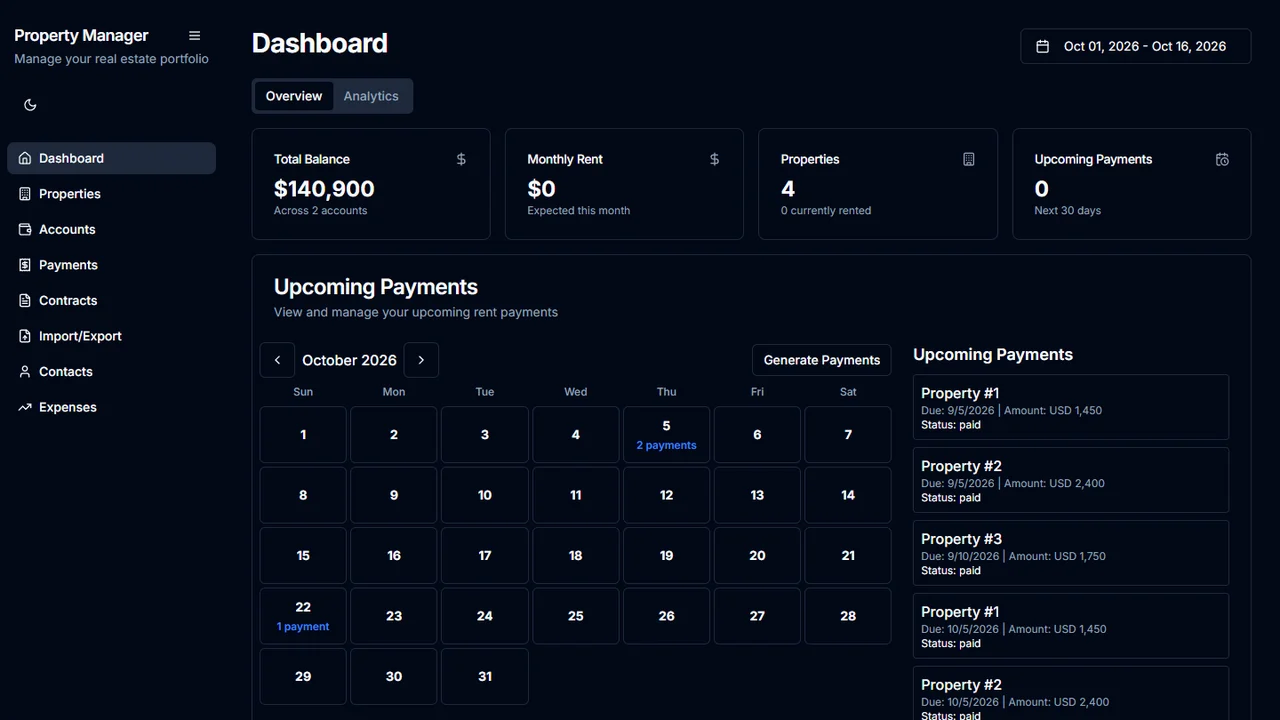
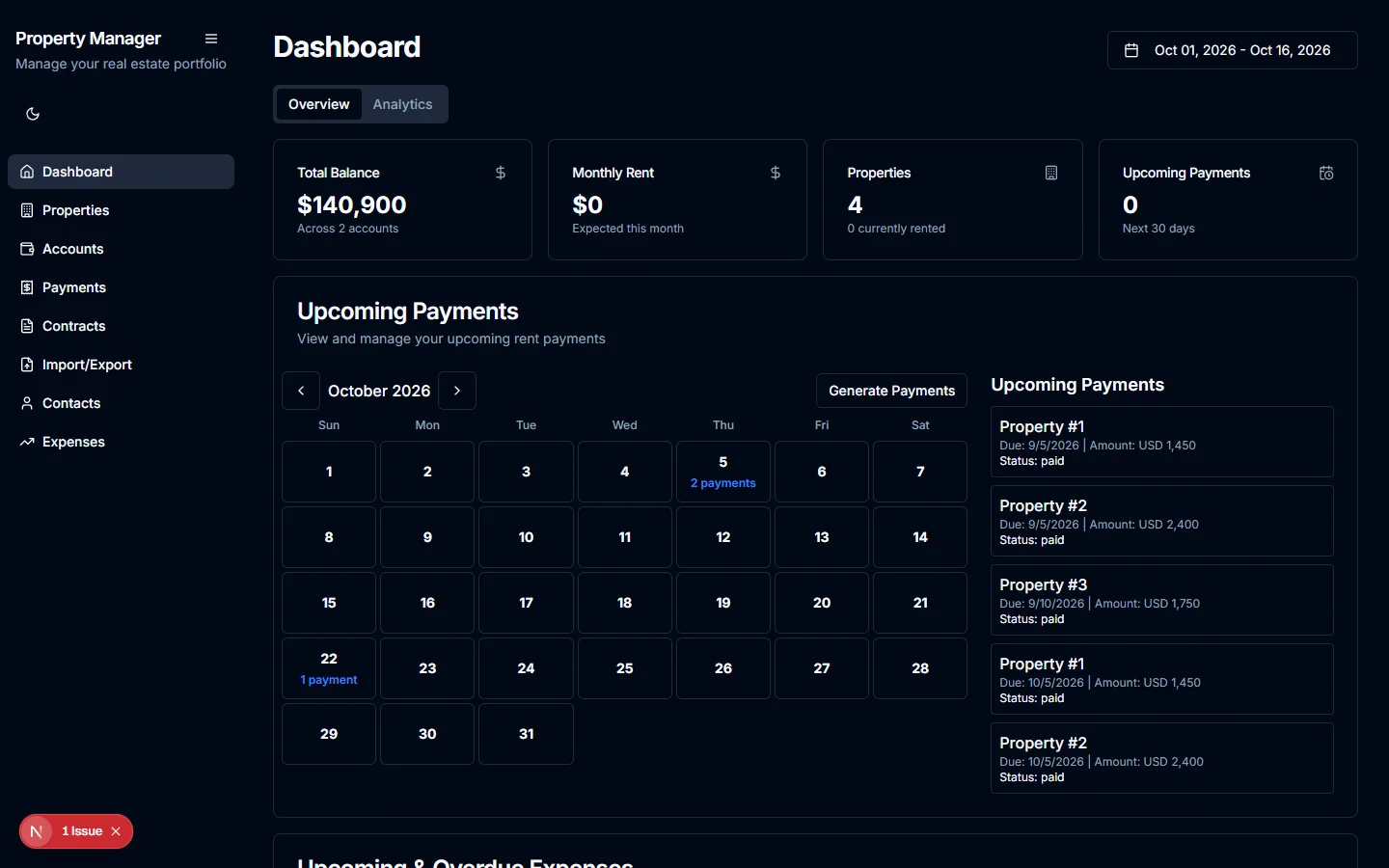 Click to zoomProperty Manager Financial Dashboard — Real-time portfolio KPIs, cashflow projections, and upcoming rent collections
1. Why IndexedDB (propManagerDB v4) Instead of a Cloud Database?#
Financial and lease records are deeply personal. By designing a custom typed IndexedDB storage engine (lib/storage-service.ts) across ten relational object stores (properties, accounts, transactions, payments, contracts, tenants, contacts, expenses, files, and history), Property Manager achieves:
- Zero Latency & 100% Offline Reliability: Filtering transactions, projecting 12-month cashflows, and switching views execute in sub-millisecond memory/IndexedDB transactions.
- Complete Data Ownership (
/import-export): The entire relational database can be exported as a single portable JSON snapshot or backed up to the user's personal Google Drive (/api/google-drive).
2. Portfolio Inventory & Automated Tax Projections#
The Properties module (app/properties/page.tsx) tracks residential and commercial units alongside their purchase valuation, current market value, linked operating bank account, and recurring municipal taxes:
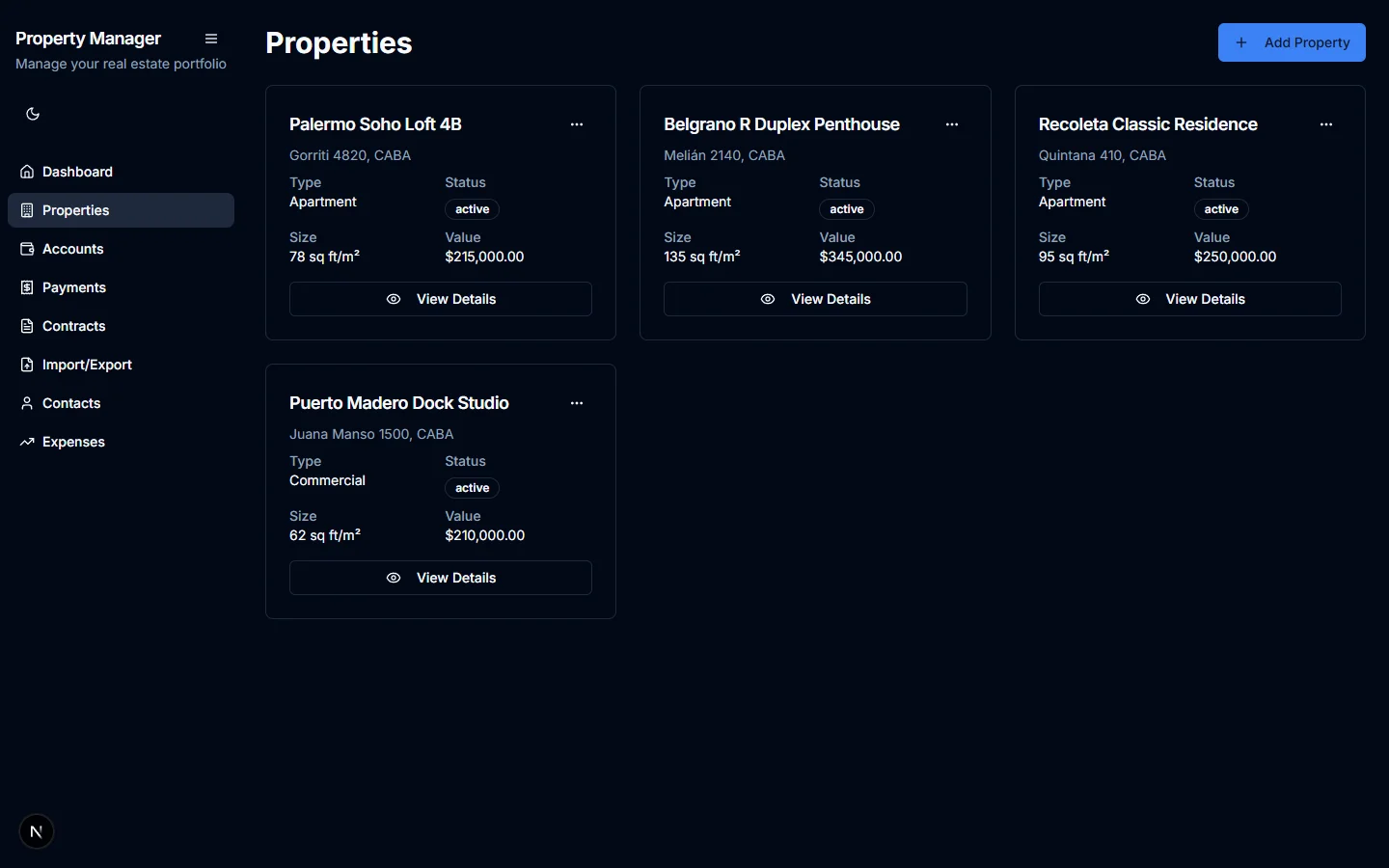 Click to zoomProperty Manager — Rental Property Portfolio View
Rather than requiring manual entry for recurring property tax bills, generateTaxExpensesForProperty() automatically synthesizes scheduled tax expense records and applies annual percentage escalations (taxIncrementPercent).
3. Multi-Step Lease Contracts (rentSteps)#
In high-inflation or multi-year commercial/residential markets, rent is rarely flat for 36 months. The Contracts engine (app/contracts/page.tsx) models leases with an arbitrary array of time-bounded rentSteps:
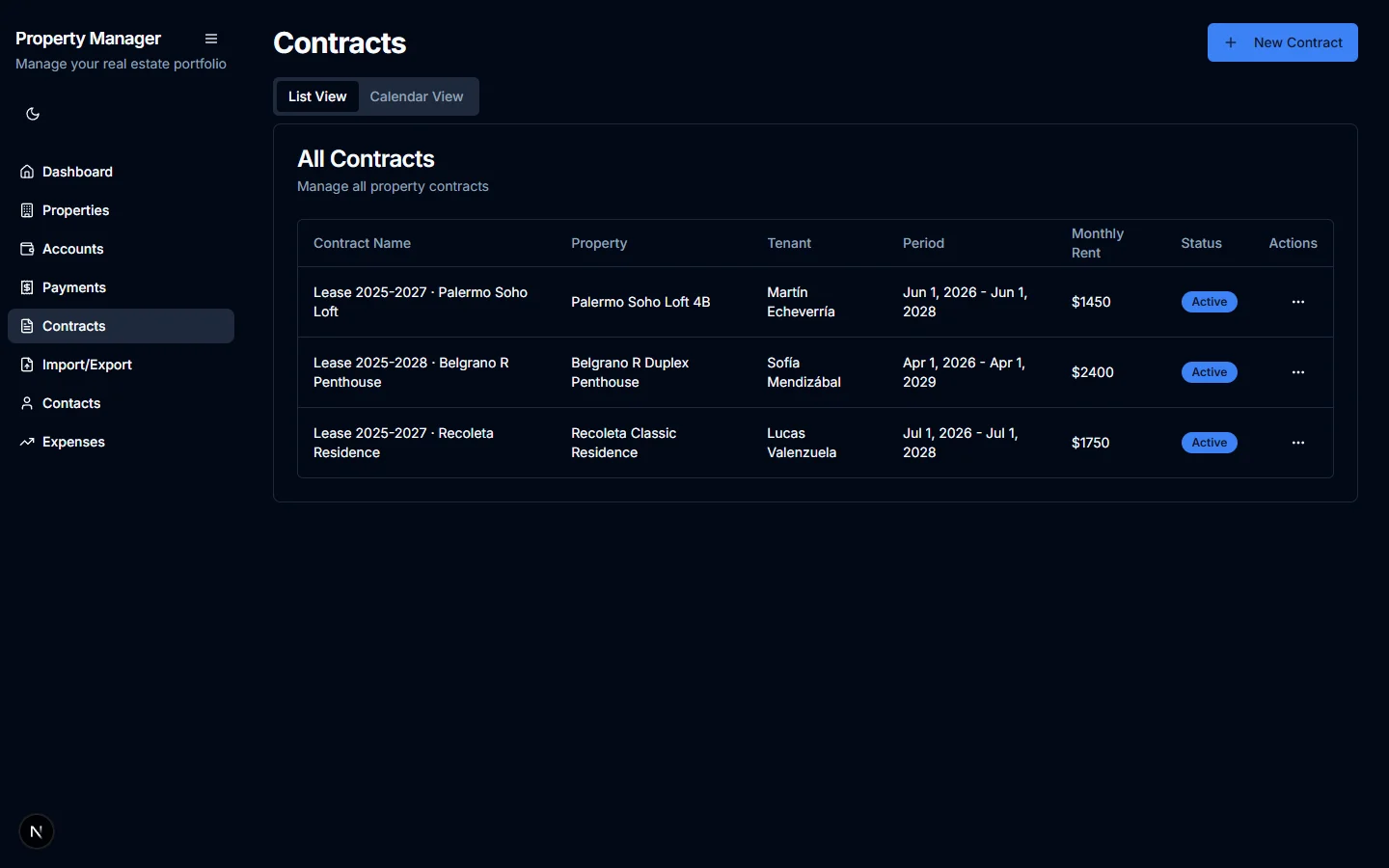 Click to zoomProperty Manager — Active Lease Contracts with Multi-Step Rent Schedules
Each contract links a property, one or more tenants (tenantIds), a realtor commission structure, security deposits, payment due days, and pass-through expense rules (tenantPaysTaxes / tenantPaysOtherExpenses).
4. Rent Collection Ledger & Cashflow Analytics#
From active contracts, the Payments engine (app/payments/page.tsx) tracks monthly rent collection across paid, pending, and overdue states, automatically reconciling settled payments into the linked bank account's transaction ledger:
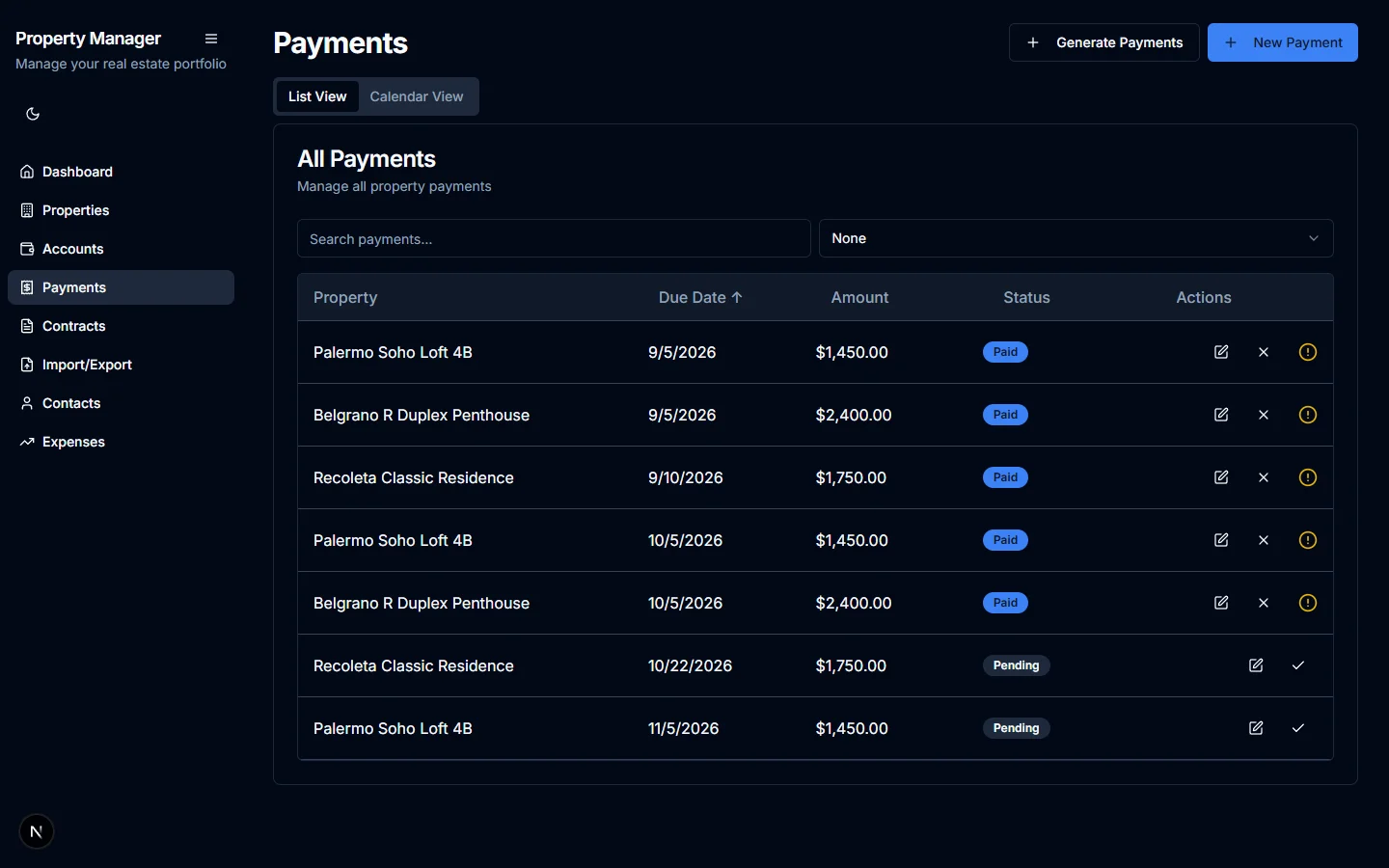 Click to zoomProperty Manager — Rent Payments & Collection Status
On the main dashboard (app/page.tsx), four interactive Recharts visualizations (FutureCashflowChart, MonthlyIncomeExpenseBarChart, IncomeExpensesPieChart, and ExpenseBreakdownPieChart) combine historical ledger transactions with future contract rentSteps to give an accurate 12-month forward cashflow projection.