
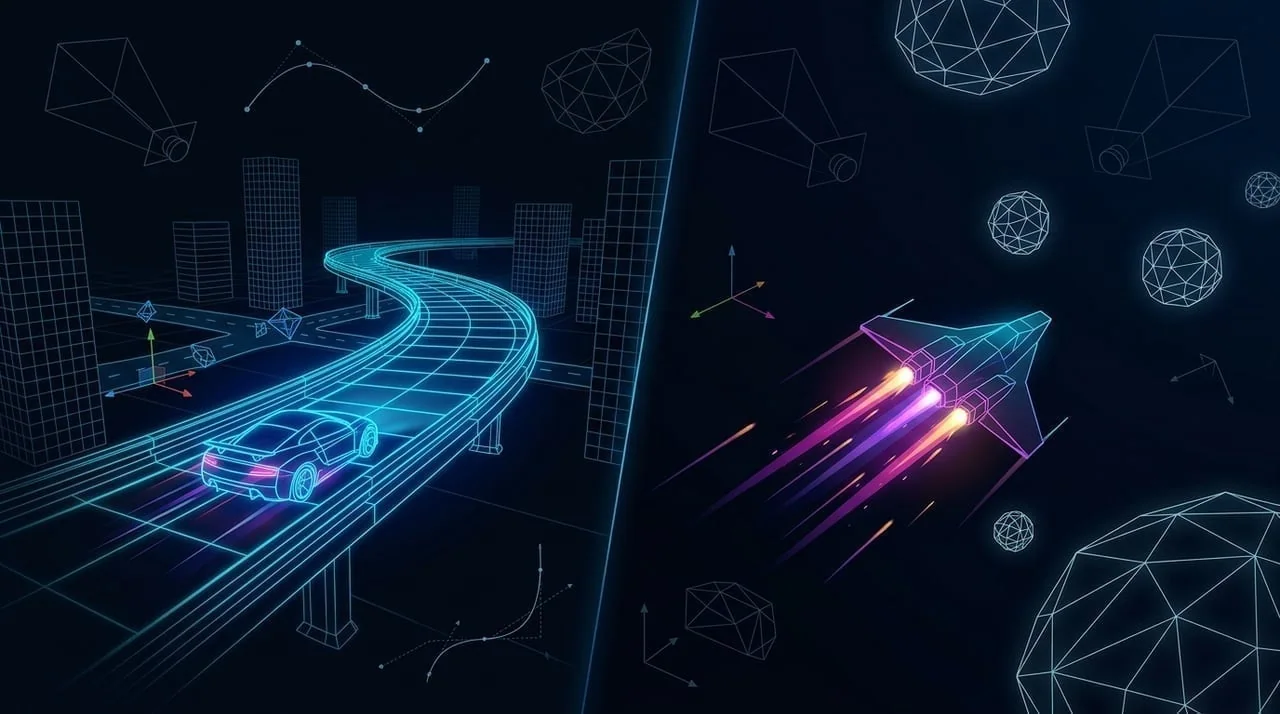
Procedural Track Generation & 2.5D Camera Physics in Early Unity 3D: City Racing & Asteroids Deluxe
Table of Contents (3 sections)▸
Back in 2010, during university game development and computer graphics courses at ITBA, I built two 3D games in C# and Unity 3D: City Racing (which went on to accumulate over 10,000 plays on Kongregate) and Asteroids Deluxe.
Both projects were exercises in squeezing maximum replayability out of lightweight procedural systems and custom camera/physics controllers.
1. City Racing: Infinite Procedural Road Networks & Spline AI#
In traditional arcade racing games, level designers spend weeks hand-modeling static tracks. For City Racing, we wanted every single race to take place on a newly generated urban circuit without ever hitting a dead end or self-intersecting road block.
Procedural Track & City Block Generation#
- Tile & Spline Continuity: As the player's car advanced, the track generator stitched modular road segments (straights, curves, intersections) and populated surrounding city blocks with randomized building prefabs and street props, recycling behind-camera chunks to keep memory flat.
- Waypoint-Driven AI Opponents: Because the track didn't exist before runtime, AI opponents couldn't rely on pre-baked navmeshes. Each spawned road segment automatically registered entry, apex, and exit waypoints; AI cars calculated steering torque toward the next apex while modulating throttle based on upcoming turn curvature.
When we published City Racing to Kongregate, over 10,000 players raced across its procedural city circuits.
2. Asteroids Deluxe: Dual-Perspective 2D Classic vs. 2.5D Chase Camera#
For Asteroids Deluxe, the goal was to take Atari's 1979 vector classic and reimagine how perspective changes spatial awareness without altering the underlying Newtonian drift physics:
- 2D Classic Orthographic Mode: A top-down orthographic camera replicating the classic arcade wrap-around playfield where players judge asteroid trajectories across all 360 degrees simultaneously.
- 2.5D Third-Person Chase Mode: With a single keypress, the camera smoothly interpolated behind the spacecraft into a 3D perspective chase view. Firing thrusters and weaving through rotating 3D asteroid fields suddenly felt like a cockpit dogfight, even though the rigid-body momentum and toroidal screen-wrapping rules remained identical under the hood.
In 2016, I migrated the original Unity 2.x/3.x C# codebases to Unity 5 WebGL so Asteroids Deluxe can be played directly in modern browsers.